By using this site, you agree to the Privacy Policy and Terms of Use.
Accept
Travel Radar - Aviation NewsTravel Radar - Aviation News
  • Breaking News
  • Aviation
    • Aircraft
    • Airlines
    • Airshow & Events
    • Careers
    • Manufacturing
  • Travel
    • Airports
    • Points & Loyalty
    • Technology
    • Trip Reviews
  • Newsletters
  • Aircraft for Sale
Reading: The “Golden Voice” in The Sky. The Story of Radio Communication
Share
Sign In
Notification Show More
Font ResizerAa
Font ResizerAa
Travel Radar - Aviation NewsTravel Radar - Aviation News
  • Breaking News
  • Aviation
  • Travel
  • Newsletters
  • Aircraft for Sale
  • Breaking News
  • Aviation
    • Aircraft
    • Airlines
    • Airshow & Events
    • Careers
    • Manufacturing
  • Travel
    • Airports
    • Points & Loyalty
    • Technology
    • Trip Reviews
  • Newsletters
  • Aircraft for Sale
Signin Sign In
Follow US
Copyright © Travel Radar Media Ltd. 2025 | All Rights Reserved
Travel Radar - Aviation News > News > The “Golden Voice” in The Sky. The Story of Radio Communication

The “Golden Voice” in The Sky. The Story of Radio Communication

Michael Cheng
Last updated: 18 July 2021 20:11
By Michael Cheng
4 Min Read
Share
SHARE

Radio has been a majority communication tool in Aviation, from the ground to air calls between pilots and air traffic controllers to the handheld walkie-talkies used by staff daily. Today we are here to give you some insights about communication in Aviation and the rationales behind using standards to ensure all transceiving messages are welly distributed.

The flight was considered a foreign concept until the Wright Brothers successfully completed the world’s first human flight in 1903. The industry snowballed, and ground crews initially relied on visual references to communicate with aircraft. Although these methods were effective for ground crews, they offered no way for pilots to speak back.

The technology of wireless communication systems in aircraft remained experimental and would take years to develop a practical prototype. Due to the limitation of weight and unreliability of radio devices, ground forces rarely used radio because signals were quickly intercepted and targeted by opposing parties. Instead, soldiers used large panel cutouts to distinguish friendly forces. These cutouts could also be used as a directional device to help pilots navigate back to familiar airfields.

Lieutenant Paul Beck made an early airborne radio transmission, aviators test a receiving set - with the airplane's engine running (US Navy/Ellyson Scrapbook Collection)

Principle of Radio Communication

In Aviation, two-way radio is comprehensively used to transmit and receive radio waves. A single radio channel operates in a half-duplex mode. Unlike the common wireless devices, only one station can send at a time via the “push-to-talk” button or Voice activation. Users are required to must take turns talking to prevent interference or “blocked. All messages will be broadcast to all users in the Frequency/ channel.
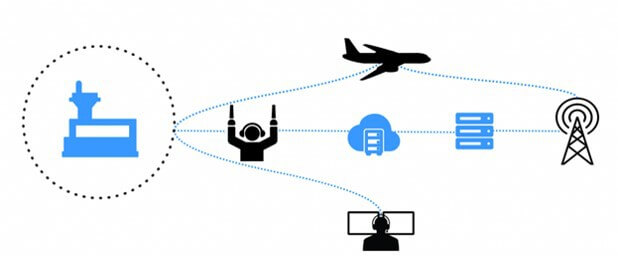
ATC Voice Communication Control System - Mobile ATC

ICAO Language Proficiency requirements

Even though English is the international aviation language, native & non-native English speakers still play a role in misunderstanding and situational awareness. ICAO have introduced  a Language Proficiency requirements to rectify multiple issues regarding accents, terminology, and interpretation in communication. The intention of the requirements is to ” reduce miscommunication as much as possible for pilots and air traffic controllers recognizing potential miscommunication when it does occur” and “that all speakers have sufficient language proficiency in handling non-routine situations.”

The structure of the LPR has six levels, pronunciation, structure, vocabulary, fluency, comprehension, and interactions. The implemented universal aviation English proficiency scale ranged from Level 1 to Level 6. Since 2008, ICAO has required that all international Air traffic controllers and pilots must obtain Level 4 or above and be continually reassessed every three years. It has also been implemented for the initial pilot assessments to ensure candidates are fulfilling the language requirement.

As a result, both pilots and ATCs need to have enough English ability to accomplish their tasks. Through education to help improve communication, implement the technique into an operational environment such as lab experience to help speakers improve their English fluency and to avoid misunderstanding, which helps non-English speakers communicate.

What are your thoughts on this article? Let us know below.

You Might Also Like

How Aviation is Changing the Way Students Travel the World
Which airlines are still flying to Russia?
eVOTL expansion via Archer Aviation’s deal with Japan Airlines
Emirates to Resume all U.S. Operations
Emirates President set for RETIREMENT
Share This Article
Facebook Twitter Email Copy Link
What’s your thoughts?
Love0
Sad0
Happy0
Angry0
ByMichael Cheng
Follow:
Aviation Reporter - Based in Hong Kong, Michael is an Aviation Journalist here at Travel Radar, covering industry insights across Asia as well as international technical development within the industry. With the solid experience in airline ground operations, Michael is currently a Quality Assurance and Compliance Monitoring Officer with a large ground-operations company. In his spare time, Michael is an avid flight-simulation fan, serving in a senior marketing role for a large multiplayer server. Alongside this, he makes regular appearances at workshops and conferences across the aviation industry
Previous Article Noida International Airport Zurich and Lucknow Join Forces To Enhance Noida International Airport
Next Article Qatar Airways plane taking off How Qatar is Preparing for World Cup 2022
Leave a Comment

Leave a Reply Cancel reply

Your email address will not be published. Required fields are marked *


Stay Connected

FacebookLike
TwitterFollow
InstagramFollow
YoutubeSubscribe

Trending News

Centre right a large white domed building with ornate trim designs and archways sits of the edge of a canal, which occupies the centre left. The picture is taken from a bridge over the canal. In the foreground, flowers and foliage along the edge of the bridge can be seen. In the background another building can be seen from a distance against a blue sky with a few small clouds.
Norse Atlantic Expands Capacity from UK to Thailand
Airlines Aviation Route Development
Two people sit in the cockpit of an aircraft. The picture is taken from behind them, focusing on the controls, which are of various bright colours against a dark background. The backs of the two people's heads are stylistically blurred. The front windows can be seen. the the view of outside is just white-ish grey, as if surrounded by clouds.
Passengers Restrain Pilot due to Mid-Flight Medical Emergency
Aircraft Aviation Incidents & Accidents
Image shows a small blue aircraft (Piper PA-28-151 Cherokee Warrior N405DS) grounded at Delaware Airpark during the day.
Fatal small plane crash in Washington
Aircraft Aviation Incidents & Accidents
Tecnam P2012 traveller aircraft flying through the clouds
Air Oceania resumes flights after fuel shortage halts operations
Aircraft Airlines Travel
Avianca Boeing 787-8 side view in flight
Avianca to relocate Fort Lauderdale operations to Terminal 4
Airlines Airports Manufacturing

Travel Radar is the leading digital hub for all things aviation and air-travel. Discover our latest aviation news, aviation data, insight and analysis.


Discover

  • Latest News
  • Subscribe
  • Weekly Digest
  • Contact Us
  • Privacy Policy
  • About Us
  • Advertising
  • Media Coverage
  • Press & Events
  • Join Our Team
  • Our Brands

Signup to our Newsletter!

And get the latest aviation news via our weekly news digest!

© Travel Radar Media Ltd. 2015-2026 | ISSN #2635-0696 | Trademark #UK00003579704
adbanner
Welcome to the TR Community!

Sign in to your account

Not a member? Sign Up