By using this site, you agree to the Privacy Policy and Terms of Use.
Accept
Travel Radar - Aviation NewsTravel Radar - Aviation News
  • Breaking News
  • Aviation
    • Aircraft
    • Airlines
    • Airshow & Events
    • Careers
    • Manufacturing
  • Travel
    • Airports
    • Points & Loyalty
    • Technology
    • Trip Reviews
  • Newsletters
  • Aircraft for Sale
Reading: Dual-Use Technologies Set to Transform Aviation Over the Next Decade
Share
Sign In
Notification Show More
Font ResizerAa
Font ResizerAa
Travel Radar - Aviation NewsTravel Radar - Aviation News
  • Breaking News
  • Aviation
  • Travel
  • Newsletters
  • Aircraft for Sale
  • Breaking News
  • Aviation
    • Aircraft
    • Airlines
    • Airshow & Events
    • Careers
    • Manufacturing
  • Travel
    • Airports
    • Points & Loyalty
    • Technology
    • Trip Reviews
  • Newsletters
  • Aircraft for Sale
Signin Sign In
Follow US
Copyright © Travel Radar Media Ltd. 2025 | All Rights Reserved
Travel Radar - Aviation News > News > Aviation > Aircraft > Dual-Use Technologies Set to Transform Aviation Over the Next Decade
AircraftAviationManufacturing

Dual-Use Technologies Set to Transform Aviation Over the Next Decade

Hannah Sass
Last updated: 3 June 2026 01:45
By Hannah Sass
5 Min Read
Share
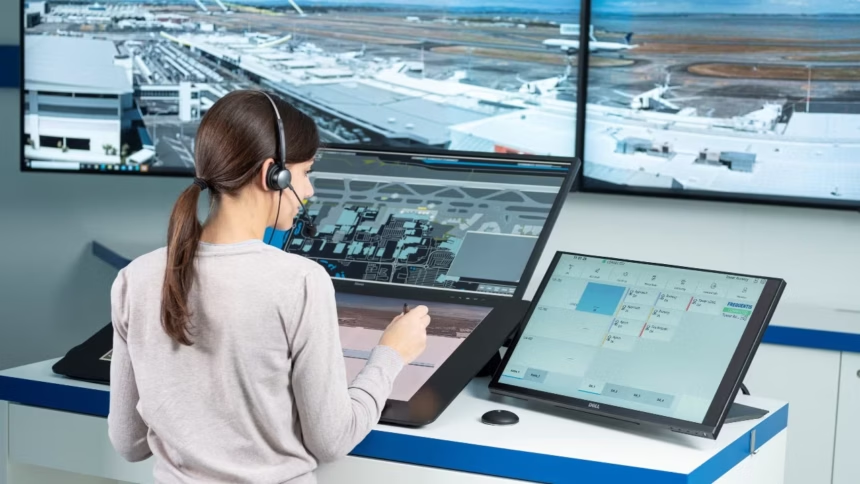
Control room, woman in foreground
As aviation becomes more connected, cybersecurity is emerging as a critical priority for airlines, airports and regulators © Airport technology
SHARE

The aviation industry is entering a new era where technologies developed for military and defence applications are increasingly shaping the future of commercial air travel.

According to a recent Forbes Technology Council analysis, so-called “dual-use technologies” — innovations with both civilian and military applications — are expected to play a major role in redefining aviation throughout the 2030s. These developments span artificial intelligence, autonomous aircraft, advanced cybersecurity, robotics and next-generation communications systems.

Aerospace engineering warehouse, wiith plane and workers
Artificial intelligence is expected to play an increasingly important role across airline operations, maintenance and flight management over the coming decade (AI Generated Image) © CPU Design

AI Moves From Support Tool to Core Infrastructure

Artificial intelligence is rapidly becoming embedded across aviation operations. Airlines and airports are increasingly using AI-powered systems to optimise flight schedules, improve fuel efficiency, predict maintenance requirements and enhance passenger experiences.

Industry analysts expect AI to evolve beyond isolated applications and become part of the operational backbone of airports and airlines. Real-time data integration, predictive analytics and automated decision-making could help operators respond to disruptions before passengers even notice them.

At the same time, AI-assisted cockpit systems are becoming more advanced, helping pilots manage complex operational environments while reducing workload and improving situational awareness.

Automation in Air Traffic Control Enhancing Efficiency and Safety
Airports are increasingly exploring robotics and automation to improve efficiency and streamline passenger operations © NATS

Autonomous Aircraft Development Accelerates

Autonomous and remotely operated aircraft continue to attract significant investment from both commercial and defence sectors.

Electric vertical take-off and landing (eVTOL) aircraft, cargo drones and autonomous flight technologies are moving from experimental projects towards real-world deployment. While fully pilotless commercial passenger flights remain some distance away, autonomous systems are already influencing cargo operations, urban air mobility projects and military aviation programmes.

The overlap between commercial and defence investment is helping accelerate development, creating opportunities for technologies to move between sectors more quickly than in previous decades.

As aircraft, airports and air traffic management systems become increasingly connected, cybersecurity is emerging as one of aviation’s most critical challenges.

Industry reports indicate cyber threats targeting aerospace and aviation organisations have risen sharply in recent years, prompting greater investment in digital resilience and network protection. Connected aircraft, biometric passenger systems and cloud-based operational platforms are creating new vulnerabilities that require constant monitoring and protection.

Experts warn that cyber resilience will become just as important as physical safety in maintaining reliable aviation operations throughout the next decade.

Airports worldwide are also exploring robotics and automation to address labour shortages and improve efficiency.

From autonomous baggage handling systems to robotic maintenance inspections and passenger assistance technologies, airports are increasingly trialling systems capable of performing repetitive or safety-critical tasks. Major international hubs are already testing robotic solutions that could eventually become standard across the industry.

Industry leaders argue that automation is designed to support employees rather than replace them, allowing staff to focus on customer service and operational decision-making.

The growing convergence between defence innovation and commercial aviation is expected to accelerate throughout the 2030s.

Historically, technologies such as GPS, fly-by-wire systems and advanced navigation tools began in military programmes before becoming essential parts of commercial aviation. Industry observers believe artificial intelligence, autonomous systems, cybersecurity infrastructure and advanced communications networks may follow a similar path.

As investment continues to flow into dual-use technologies, the aviation sector could see one of its most significant periods of technological transformation since the arrival of the jet age.

What do you think will have the biggest impact on aviation over the next decade — AI, automation or autonomous aircraft? Let us know in the comments.
You Might Also Like

Climate research flights reach 30 year milestone
Prestwick Airport marks sixth consecutive profitable year
Emirates set to serve its Vegan Customers from 2027
EasyJet: Launch of new base in Newcastle, Creating 1,200 job opportunities in UK
Aurigny Unveils New Route Linking Guernsey to Genoa
Share This Article
Facebook Twitter Email Copy Link
What’s your thoughts?
Love0
Sad0
Happy0
Angry0
ByHannah Sass
Aviation Reporter - A journalism graduate with interests in social media, entertainment, fashion journalism and radio, alongside marketing and public relations. They have experience using Adobe InDesign and have developed skills in writing articles and reviews across a range of topics.
Previous Article Image shows Airbus 350-1000 aircraft in flight at the Paris Airshow 2019 World’s first direct flight from London to Sydney delayed by a further four months
Leave a Comment

Leave a Reply Cancel reply

Your email address will not be published. Required fields are marked *


Stay Connected

FacebookLike
TwitterFollow
InstagramFollow
YoutubeSubscribe

Trending News

Image shows Airbus 350-1000 aircraft in flight at the Paris Airshow 2019
World’s first direct flight from London to Sydney delayed by a further four months
Aircraft Airlines Aviation Manufacturing
A plane landing at an airport with tall buildings in the background
London City Airport faces challenge over planned expansion
Airports Aviation
Fuel tanks on tracks
Russia Bans Aviation Fuel Exports for the First Time Amid Refinery Pressure
Aircraft Airline Economics Aviation
Two men seated on separate blue upholstered armchairs on a stage, facing slightly towards each other. One person wears a dark business suit, crosses their legs, and gestures with one hand, while the other wears a dark formal uniform with insignia and sits upright. A small wooden side table stands between the chairs, with a water bottle on the floor nearby. The stage is lit from above, with a patterned rug underfoot and a dark backdrop with vertical blue lighting panels behind the men.
United Airlines CEO dismisses JetBlue merger rumours
Airline Economics Airlines Aviation
Image shows a Virgin Atlantic Airbus A300-900 in the air
Virgin Atlantic engine stalls mid-flight over ocean
Aircraft Aviation Incidents & Accidents

Travel Radar is the leading digital hub for all things aviation and air-travel. Discover our latest aviation news, aviation data, insight and analysis.


Discover

  • Latest News
  • Subscribe
  • Weekly Digest
  • Contact Us
  • Privacy Policy
  • About Us
  • Advertising
  • Media Coverage
  • Press & Events
  • Join Our Team
  • Our Brands

Signup to our Newsletter!

And get the latest aviation news via our weekly news digest!

© Travel Radar Media Ltd. 2015-2026 | ISSN #2635-0696 | Trademark #UK00003579704
adbanner
Welcome to the TR Community!

Sign in to your account

Not a member? Sign Up