By using this site, you agree to the Privacy Policy and Terms of Use.
Accept
Travel Radar - Aviation NewsTravel Radar - Aviation News
  • Breaking News
  • Aviation
    • Aircraft
    • Airlines
    • Airshow & Events
    • Careers
    • Manufacturing
  • Travel
    • Airports
    • Points & Loyalty
    • Technology
    • Trip Reviews
  • Newsletters
  • Aircraft for Sale
Reading: A Closer look into Sustainable Aviation Fuel
Share
Sign In
Notification Show More
Font ResizerAa
Font ResizerAa
Travel Radar - Aviation NewsTravel Radar - Aviation News
  • Breaking News
  • Aviation
  • Travel
  • Newsletters
  • Aircraft for Sale
  • Breaking News
  • Aviation
    • Aircraft
    • Airlines
    • Airshow & Events
    • Careers
    • Manufacturing
  • Travel
    • Airports
    • Points & Loyalty
    • Technology
    • Trip Reviews
  • Newsletters
  • Aircraft for Sale
Signin Sign In
Follow US
Copyright © Travel Radar Media Ltd. 2025 | All Rights Reserved
Travel Radar - Aviation News > News > A Closer look into Sustainable Aviation Fuel

A Closer look into Sustainable Aviation Fuel

Leo Cheung
Last updated: 8 October 2021 18:20
By Leo Cheung
6 Min Read
Share
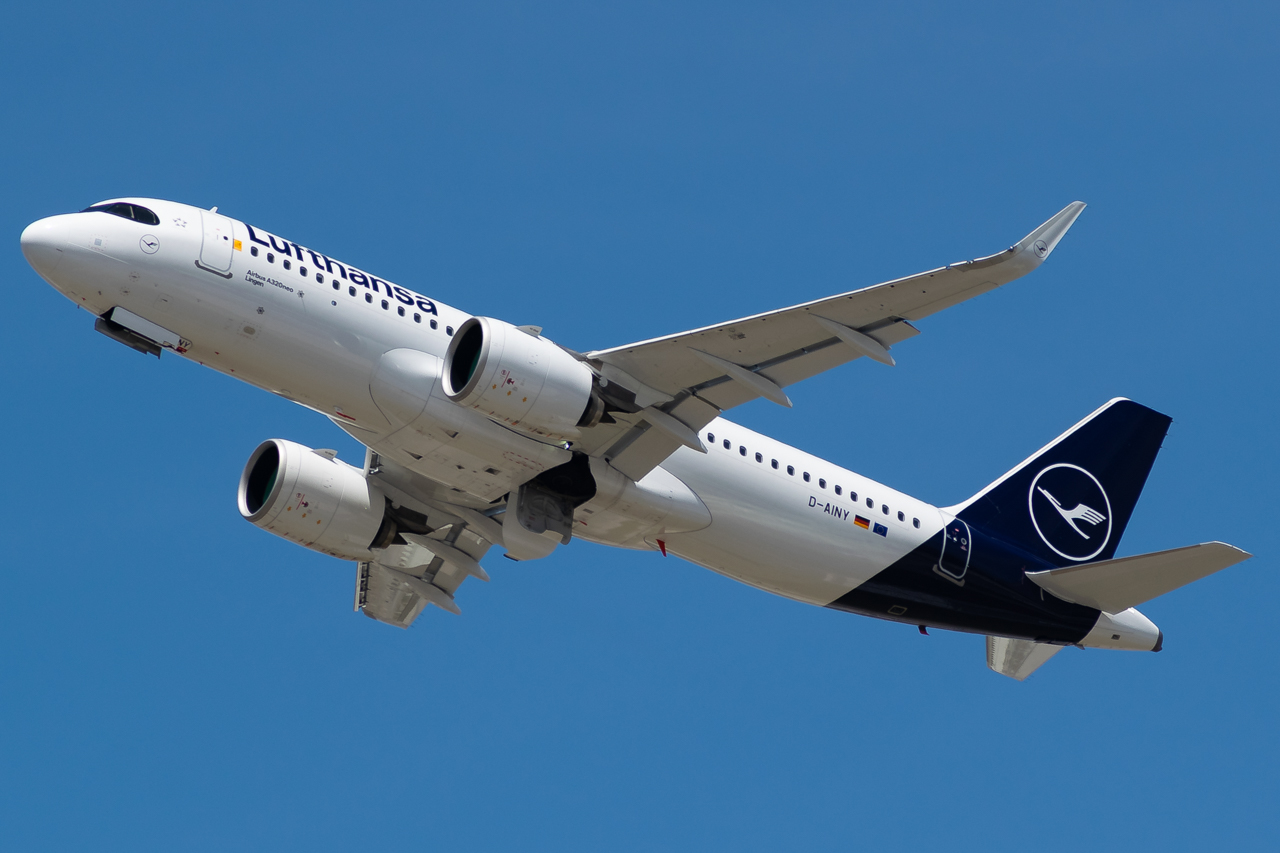
Lufthansa Airbus Take-off
Lufthansa © TravelRadar Marco Macca
SHARE

Earlier this week, Cathay Pacific has announced its partnership with Hong Kong and China Gas (Towngas) to produce Bio-fuel by the end of 2021. The production will be implemented in Zhangjiagang City in China, with an annual aim to produce 50,000 tonnes initially. The announcement reinforces the airlines’ agreement to use 10% of bio-fuel by the year 2030 alongside other members of Oneworld Alliance. Interestingly, Lufthansa has also announced the official opening of its sustainable fuel production site in Werlte, Germany. With more airlines and alliances committing to bio-fuel, it is not hard to see that this is the greener way to go but what exactly is bio-fuel and how will it impact the industry is the next question in mind.

Summary
Bio-fuel, alternative fuel or SAF?Benefits of SAFWhat do we see in the future?

Bio-fuel, alternative fuel or SAF?

Formerly referred to as bio-fuel, IATA (International Air Transport Association) has defined SAF (Sustainable Aviation Fuel) to be used as the preferred term to describe unconventional fuel, a.k.a. alternative fuel, that is produced using animal and plant waste. While “bio-fuel”, may not be technically correct as the current technology also allows us to produce fuel using non-biological resources, the term, SAF, is preferred to highlight the sustainable nature of this type of fuel.

SAF has almost identical chemical and physical properties to conventional fuel which allows it to be mixed in, and used with, conventional fuel without modifications to the aircraft systems and engines. However, there is a rigid restriction of the mixture ratio recommended by manufacturers when operating with SAF.

Benefits of SAF

In using conventional fuel, CO2 is released after fuel is passed through the combustion chamber of an aircraft as greenhouse gases. Basically, what this means is that CO2 previously stored underground is released into our atmosphere, and this is referred to as carbon footprint and it contributes to the total greenhouse gas emissions that have negative impacts on our environment. SAF, however, is produced by the decomposition of biomass which takes in CO2 throughout its lifecycle. Therefore, the release of CO2 after combustion would simply mean that the carbon composition is “returned” to the atmosphere. The amount of CO2 intake and output of using SAF is very similar, therefore, it can be said that SAF is virtually CO2 neutral. However, in reality, the transport of the fuel and raw material will also require CO2 emission, but it has been shown that the use of SAF can reduce the carbon emission up to 80% compared to traditional fuel.

We all know that fossil fuel is not without its end, the use of SAF can diversify the source of fuel and make use of geographic advantages in certain parts of the world, depending on its environment and needs. The typical raw material of SAF includes algae, inedible plants with high lipid contents, used cooking oil, municipal waste and non-biological by-product of factories. Most of these materials are not consumable in our lives, but the use of SAF will allow them to gain new values.

The cost of fuel is the major expense of flight operations and it accounts for more than 20% of the operational cost in an airline. SAF is also a more stable source of fuel when compared to conventional fossil fuel, which has very fluctuant prices and it allows areas with low yield for edible crops to generate revenue. Some sources of SAF are by-products of factories and would otherwise be considered pollutants and buried underground. This particularly highlights the sustainability of SAF.

What do we see in the future?

With raised awareness around the world, ICAO has taken the initiative to implement the Carbon Offsetting and Reduction Scheme for International Aviation (CORSIA), for all airlines to reduce CO2 emission for international flights for participating countries. In the year 2021, we are in the first stage of the scheme, where countries are only highly recommended to participate and is voluntary. The scheme will enter the second phase from 2027 to 2035 where only some less developed countries are exempt. Countries, whether previously volunteered or not, will be subject to being offset if the emission requirements are not met.
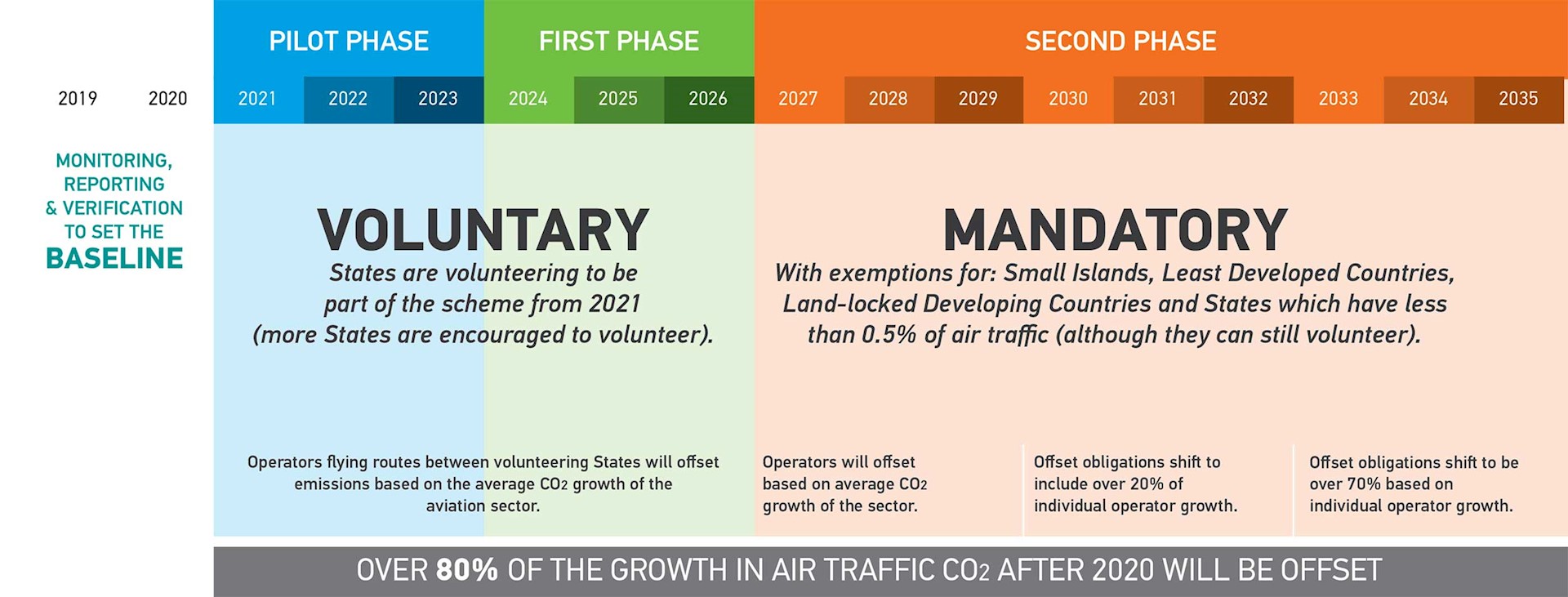
visualize the steps of CORSIA
Stages of CORSIA |©aviationbenefits.org

The use of SAF is currently less than 1% of total airlines consumption in 2019, with the main problem simply being that not enough SAF was produced. IATA believes that now is the best time to develop a SAF industry and there is no reason why SAF cannot become the main source of aviation fuel one day.

With major airlines like Lufthansa and Cathay Pacific implementing the production of SAF, do you think one day it will become the main source of jet fuel?

You Might Also Like

Lufthansa Lounge Reopens at Stuttgart Airport
Emirates to Introduce Refreshed Boeing 777s on Flights to Riyadh
British Airways Flight diverts to Frankfurt
Most passengers are satisfied with UK airport security processes, reveals survey
Japan Airlines Invests Into Low-cost Carrier Spring Airlines Japan
Share This Article
Facebook Twitter Email Copy Link
What’s your thoughts?
Love0
Sad0
Happy0
Angry0
ByLeo Cheung
Follow:
Aviation Reporter - Born and raised in Hong Kong, Leo has decided to pursue a career in aviation under the influence of the old Kai Tak Airport back in the days. With a degree in aviation, he has joint Travel Radar as an aviation reporter to diversify his views and apply professional knowledge to anyone who is interested in commercial aviation. He regularly contributes articles with 'inside the cockpit' knowledge.
Previous Article True Noord lease Embraer E190 to Cobham Aviation Service Cobham Signs 6 Year Lease For Embraer E190 From TrueNoord
Next Article Shows 738 being used by GBA Air Operator Certificate issued to Greater Bay Airlines in Hong Kong
1 Comment

Leave a Reply Cancel reply

Your email address will not be published. Required fields are marked *


Stay Connected

FacebookLike
TwitterFollow
InstagramFollow
YoutubeSubscribe

Trending News

A Boeing 737 Max 9 flying on blue sky, the new moving assembly line replicates Boeing's existing 737 production system used at its Renton factory
Boeing launches fourth 737 MAX assembly line to boost production
Aircraft Aviation Manufacturing
An image of a Corendon Airlines Boeing 737-8 MAX
Corendon Airlines Rolls Out New Self-Service Airport Kiosks
Airlines Airports Technology
A Southwest Airlines plane in flight. The aircraft is cobalt blue, with white branding along the side of the fuselage. The tail of the aircraft, which is to the right of the image, is bright red and egg-yolk yellow. The background is bright cloudless blue sky.
Southwest Airlines Flight Bound for Vegas Makes Emergency U-Turn to Hawaii
Aircraft Aviation Incidents & Accidents
An image of Gatwick and Air Arabia employees holding a large boarding pass standing in front of a Air Arabia aircraft
Air Arabia Launches New London Gatwick-Sharjah services
Airlines Airports Route Development
Terminal 2 of Manchester Airport. A row of shops can be seen lineing either wall of the terminal, with seating in the centre and walkways either side. The walls are predominently grey aside from the branding of the shops, and the scene is lit by fluorescent white overhead lights lined across the ceiling.
Neurodivergent Advocate Shares Accessibility Concerns at Manchester Airport
Airports Aviation Travel

Travel Radar is the leading digital hub for all things aviation and air-travel. Discover our latest aviation news, aviation data, insight and analysis.


Discover

  • Latest News
  • Subscribe
  • Weekly Digest
  • Contact Us
  • Privacy Policy
  • About Us
  • Advertising
  • Media Coverage
  • Press & Events
  • Join Our Team
  • Our Brands

Signup to our Newsletter!

And get the latest aviation news via our weekly news digest!

© Travel Radar Media Ltd. 2015-2026 | ISSN #2635-0696 | Trademark #UK00003579704
adbanner
Welcome to the TR Community!

Sign in to your account

Not a member? Sign Up