By using this site, you agree to the Privacy Policy and Terms of Use.
Accept
Travel Radar - Aviation NewsTravel Radar - Aviation News
  • Breaking News
  • Aviation
    • Aircraft
    • Airlines
    • Airshow & Events
    • Careers
    • Manufacturing
  • Travel
    • Airports
    • Points & Loyalty
    • Technology
    • Trip Reviews
  • Newsletters
  • Aircraft for Sale
Reading: Airbus Demonstrates Automatic Take Off
Share
Sign In
Notification Show More
Font ResizerAa
Font ResizerAa
Travel Radar - Aviation NewsTravel Radar - Aviation News
  • Breaking News
  • Aviation
  • Travel
  • Newsletters
  • Aircraft for Sale
  • Breaking News
  • Aviation
    • Aircraft
    • Airlines
    • Airshow & Events
    • Careers
    • Manufacturing
  • Travel
    • Airports
    • Points & Loyalty
    • Technology
    • Trip Reviews
  • Newsletters
  • Aircraft for Sale
Signin Sign In
Follow US
Copyright © Travel Radar Media Ltd. 2025 | All Rights Reserved
Travel Radar - Aviation News > News > Airbus Demonstrates Automatic Take Off

Airbus Demonstrates Automatic Take Off

Travel Radar Staff
Last updated: 26 January 2020 20:05
By Travel Radar Staff
2 Min Read
Share
SHARE

On December 18th last year, Airbus successfully conducted the first completely automatic take-offs.

As part of the Autonomous Taxi, Take Off and Landing (ATTOL) project, an A350-1000 with two pilots, two flight test engineers and a test flight engineer conducted a series of eight take offs over a four-and-a-half-hour period from the company base at Toulouse in France.
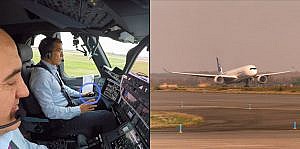
Look ma, no hands! Airbus demonstrates automatic takeoffs  All Images ©Airbus

While automated landings using the Instrument Landing System (ILS) have been used since 1938, that system relies on ground-based transmissions, whereas the Airbus automated take off is entirely internal to the aircraft.

The chief test pilot, Captain Yann Beaufils reported that the system operated as expected. ‘We moved the throttle levers to the take-off setting and we monitored the aircraft. It started to move and accelerate automatically maintaining the runway centreline, at the exact rotation speed as entered in the system. The nose of the aircraft began to lift up automatically to take the expected take-off pitch value and a few seconds later we were airborne‘, he said. The system uses image-recognition technology to maintain the runway centreline.

The next stage will be automatic vision-based taxi and landing sequences later this year. The company says that the technology is not an end in itself, but a means to improve safety, air traffic management and to address pilot shortages. They emphasise that these technologies are intended to support not replace pilots.

Nevertheless, the Swiss bank UBS has suggested single-pilot commercial and cargo aircraft could be available in the next five years, their calculations indicating single pilot operations could save as much as $15 million in salary, training, fuel and insurance costs.
You Might Also Like

Heathrow Cuts Passenger Numbers by a Third
CO₂ Emissions to Sustainable Aviation Fuel: How Finland is Piloting Production
Why Thailand Remains a Dream Destination – And a Place to Retire
Emirates newly retrofitted Boeing 777 will operate between Melbourne and Dubai
New UK carrier Sentra Airways gains first aircraft
Share This Article
Facebook Twitter Email Copy Link
What’s your thoughts?
Love0
Sad0
Happy0
Angry0
ByTravel Radar Staff
Follow:
Articles from guest contributors wishing to remain anonymous are credited to this account. Want to contribute to Travel Radar either in-name, or anonymously? Get in touch: [email protected]
Previous Article South African Airways Puts A340s Up for Sale
Next Article New Airport for Addis Ababa
1 Comment

Leave a Reply Cancel reply

Your email address will not be published. Required fields are marked *


Stay Connected

FacebookLike
TwitterFollow
InstagramFollow
YoutubeSubscribe

Trending News

Image shows a Boeing 737 Max 10 demonstrator
Boeing 737 MAX 10 could be approved this week
Aircraft Airlines
Photo of a Daher aircraft in the sky above the sea facing eastwards
Daher Kodiak 900 Expands into Europe
Aircraft Airshow & Events
Side view of an American Airlines narrow‑body passenger jet in flight, identified as an Airbus A320, descending with landing gear extended. The silver-grey fuselage carries the “American” name in dark lettering, while the tail features the airline’s red, white and blue striped design. The aircraft is lit by warm, low sunlight against a softly clouded sky, with both engines and wing details clearly visible.
American Airlines to New Flights in January 2027
Airlines Route Development
Two Air New Zealand aircraft on airport taxiways, including a De Havilland Q300 turboprop in the foreground and an Airbus narrowbody aircraft in the background, with airport buildings and residential areas visible beyond the airfield.
Air New Zealand Q300 Incident Prompts Safety Findings
Airlines Incidents & Accidents
An up-close image of the outside of the entrance of Doncaster Sheffield Airport. The building is made of glass panels which reflect the sky and clouds. Viewable is white lettering that says 'Doncaster Sheffield'.
UK’s Doncaster Sheffield Airport set to become publicly owned
Airports Aviation

Travel Radar is the leading digital hub for all things aviation and air-travel. Discover our latest aviation news, aviation data, insight and analysis.


Discover

  • Latest News
  • Subscribe
  • Weekly Digest
  • Contact Us
  • Privacy Policy
  • About Us
  • Advertising
  • Media Coverage
  • Press & Events
  • Join Our Team
  • Our Brands

Signup to our Newsletter!

And get the latest aviation news via our weekly news digest!

© Travel Radar Media Ltd. 2015-2026 | ISSN #2635-0696 | Trademark #UK00003579704
adbanner
Welcome to the TR Community!

Sign in to your account

Not a member? Sign Up