
When we see aircraft incidences, accidents and emergencies both in the news and on social media, it can create worry or more extremely a fear of flying, otherwise known as ‘aerophobia’ or ‘aviophobia’. In this article, we will review recent aircraft incidents data and explore safety information to try to answer the question, how safe is it to fly?
IATA Safety Report
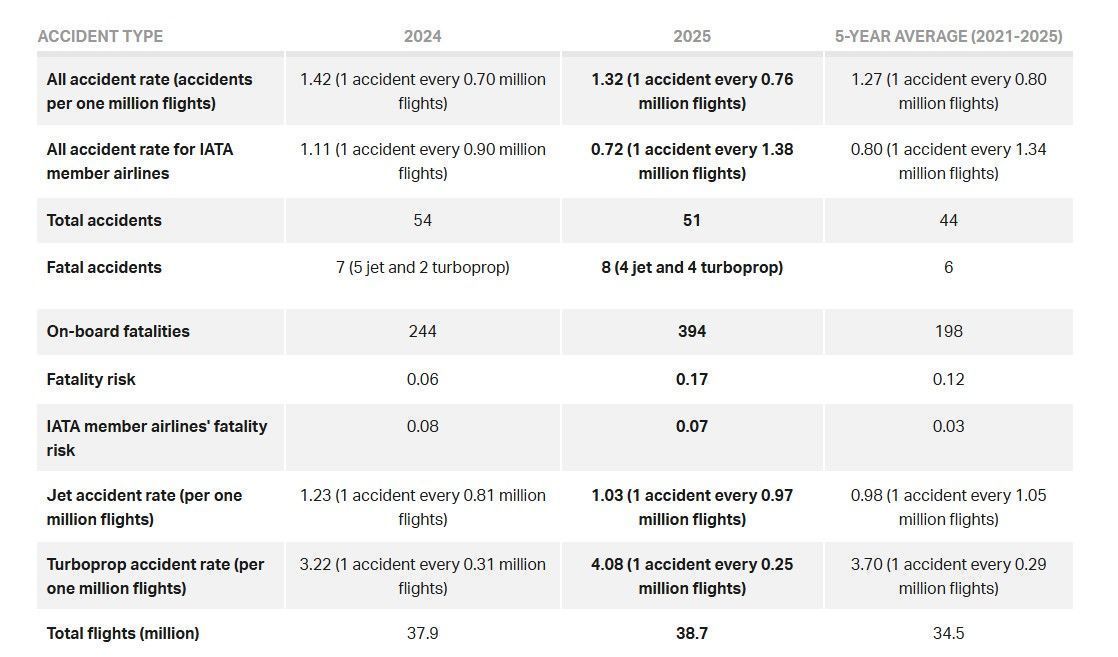
The International Air Transport Association (IATA) published its Annual Safety Report on March 17, 2026 detailing the total number of accidents in the aviation industry, fatal or otherwise. In 2025, just 51 accidents were recorded out of 38.7 million flights, approximately one accident for 760,000 flights. There were 8 fatal accidents, sadly causing 394 reported on-board deaths.
The five year average for fatal accidents was reported to have improved, with just one fatal accident for every 5.6 million flights. Common accidents were caused by tail strikes, landing gear events, runway excursions and ground damage. The report also highlighted that there were no flight accidents caused by ‘loss of control’ in 2025, a category associated with the most serious aviation accidents.
Fatal accidents in 2025
Two catastrophic events accounted for more than half of all the onboard losses in 2025. The first was an unusual and tragic mid-air collision of an American Airlines (AA) regional jet with a U.S. Army Black Hawk helicopter near Washington Ronald Reagan National Airport (DCA) on Jan. 29, which claimed 67 lives.
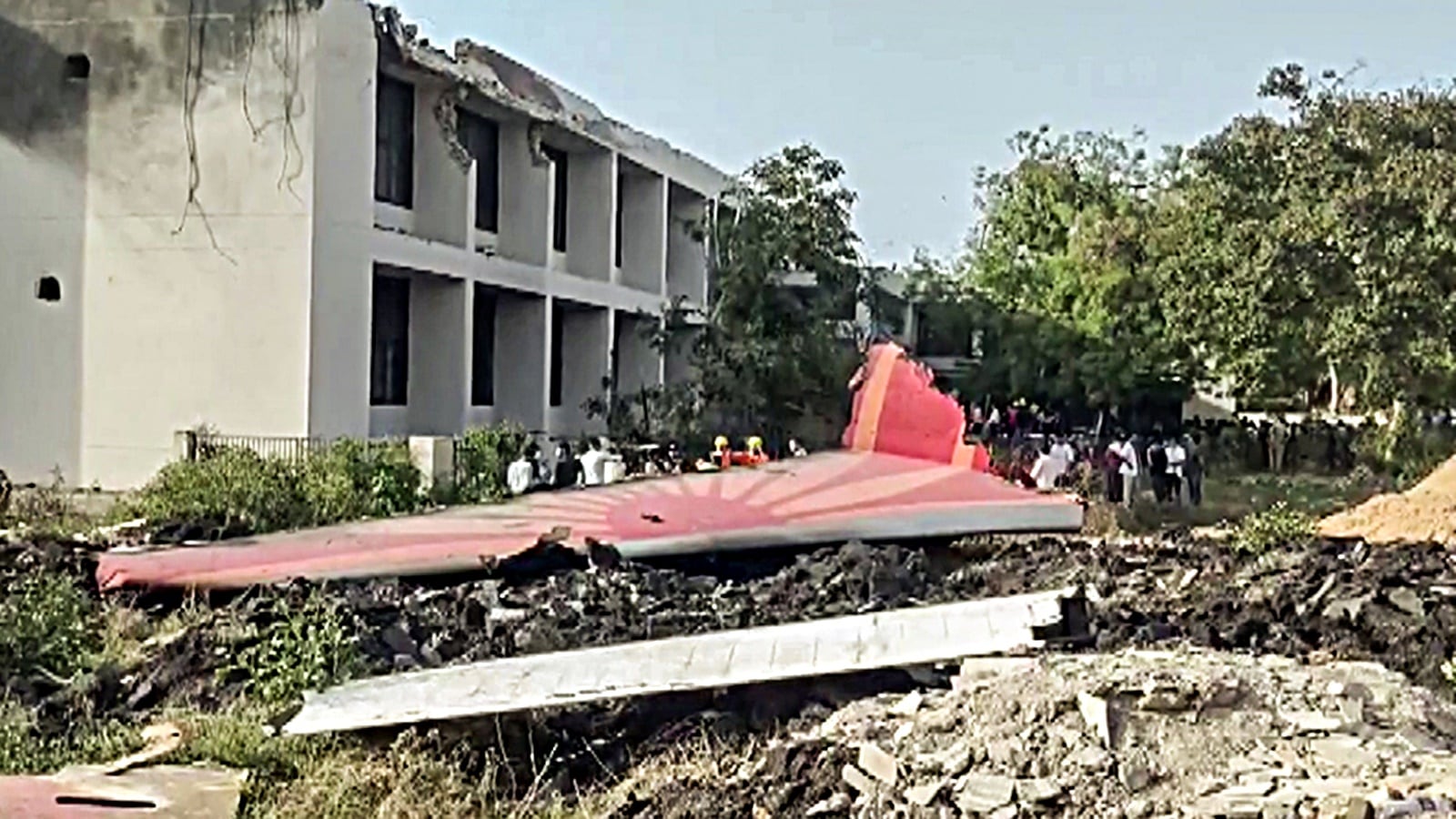
The second was when an Air India (AI) aircraft crashed into a medical college hostel shortly after take off in Ahmedabad, on June 12. With a devastating 241 onboard fatalities plus 19 on-the-ground fatalities (total 260), this was the worst commercial aviation accident in nearly 11 years (surpassing all recorded fatality totals since the 2014 loss of Malaysia Airlines Flight MH370, which resulted in 239 fatalities).

The story in 2026, so far
In 2026, using reports by Travel Radar up to June 17, we have already seen 15 fatal accidents with a loss of 49 lives. Just one of these was on a commercial aircraft however, as the majority involved small aircraft or helicopters. So whilst unfortunately, there have already been more fatal accidents than seen in 2025, there have been far fewer deaths.
Links to the relevant articles are attached to the crash locations.
| Month in 2026 | Number of fatalities | Location and aircraft |
| January | 6 | Paipa, Colombia – private aircraft |
| January | 5 | Western India – Bombardier Learjet |
| February | 4 | Colorado – private aircraft |
| February | 1 | Yorkshire – small aircraft |
| March | 2 | Namibia – light aircraft |
| March | 2 | New York – Air Canada Express |
| April | 5 | Amarillo – small aircraft |
| April | 2 | Minnesota – small aircraft |
| April | 2 | Arizona – small plane |
| April | 2 | Derbyshire – small plane |
| May | 2 | Ohio – small plane |
| May | 4 | New Mexico – private aircraft |
| May | 4 | Croatia – small aircraft |
| June | 6 | Rio de Janeiro – 2 helicopters |
| June | 3 | Devon – helicopter |
| TOTAL | 49 | Worldwide – data Jan. to June 17, 2026 |
Whilst the months of January and April both saw 11 fatalities, January and June both had incidents with the greatest losses, 6 lives. These events will still be being analysed to find out exactly what happened in order to prevent future reoccurrences.
Travel Radar has also reported on many emergency landings this year, but luckily with very few injuries and no fatalities recorded.

Reassurances
In the U.S., the Federal Aviation Administration (FAA) and National Transportation Safety Board (NTSB) have stated that commercial aviation is still statistically the safest form of transportation per mile travelled. Driving is said to be 95 times more dangerous per mile travelled than commercial flying.
A U.S. study by MIT & Harvard found the odds of being in a fatal plane accident are approximately 1 in 11 million flights. It is probably also worth knowing, that the requirements for commercial airlines (set by the FAA in the U.S. and in Europe the European Union Aviation Safety Agency (EASA)) are to have two to three back up systems for every critical aviation component.
The FAA and NTSB have also highlighted that turbulence has never actually caused a modern aircraft to crash. However, this is cited as the most common trigger for people to be scared of flying. Other stated reasons are worries about take-off and landing, health anxieties, strange sounds, feeling trapped or having a loss of control during flights.
Commercial Pilot and Fear of Flying Therapist, Captain Alex Gervash, stated:
“In my experience treating 16,000+ cases, the real trigger is rarely what people think it is. Most people say they are afraid of the plane crashing. But when we work deeper, we find it is actually about their nervous system responding to a perceived loss of control.”
The good news is that there are professional treatment options such as Cognitive Behavioural Therapy (CBT) as well as newer technology application treatments like SkyBuddy which can provide an expert to text you support during a flight.
The benefits of flying do outweigh the measured and rare risks, but as IATA Director General Willie Walsh reinforces:
“Every accident is one too many, and the industry remains committed to continuously strengthening safety through rigorous analysis, cooperation and the sharing of data.”
Statistics may not alone cure a fear of flying, as fear is processed in the emotional rather than rational part of the human brain. But it is important to remember that therapies and help are always available.
Our condolences go to those who lost loved ones in these reported fatal incidents.