By using this site, you agree to the Privacy Policy and Terms of Use.
Accept
Travel Radar - Aviation NewsTravel Radar - Aviation News
  • Breaking News
  • Aviation
    • Aircraft
    • Airlines
    • Airshow & Events
    • Careers
    • Manufacturing
  • Travel
    • Airports
    • Points & Loyalty
    • Technology
    • Trip Reviews
  • Newsletters
  • Aircraft for Sale
Reading: Sunbathing Tortoise causes Runway Closure in Narita Airport
Share
Sign In
Notification Show More
Font ResizerAa
Font ResizerAa
Travel Radar - Aviation NewsTravel Radar - Aviation News
  • Breaking News
  • Aviation
  • Travel
  • Newsletters
  • Aircraft for Sale
  • Breaking News
  • Aviation
    • Aircraft
    • Airlines
    • Airshow & Events
    • Careers
    • Manufacturing
  • Travel
    • Airports
    • Points & Loyalty
    • Technology
    • Trip Reviews
  • Newsletters
  • Aircraft for Sale
Signin Sign In
Follow US
Copyright © Travel Radar Media Ltd. 2025 | All Rights Reserved
Travel Radar - Aviation News > News > Sunbathing Tortoise causes Runway Closure in Narita Airport

Sunbathing Tortoise causes Runway Closure in Narita Airport

Leo Cheung
Last updated: 2 October 2021 00:41
By Leo Cheung
5 Min Read
Share
SHARE

On the 24th of September, 5 flights operating in Narita International Airport were delayed due to an unexpected guest taking a morning stroll on the active runway. This incident was reported at around 11.30am when the pilot of a flight about to take-off spotted a tortoise on the active runway. Narita International Airport Corp. decided to close the active runway for 12 minutes for the airport staff to rescue the wandering reptile and a total of 5 departing flights were delayed for approximately 15 minutes. The captured tortoise was reported to weigh 2.1kg and was about 30cm in length and is currently in the care of the Narita Airport International Corp. until they decide what to do with it. Despite the disruption, the cabin crew on one of the delayed flights reported that their passengers were not particularly concerned about the delay and took off with a rather cheerful demeanor after being informed about the cause of the delay.
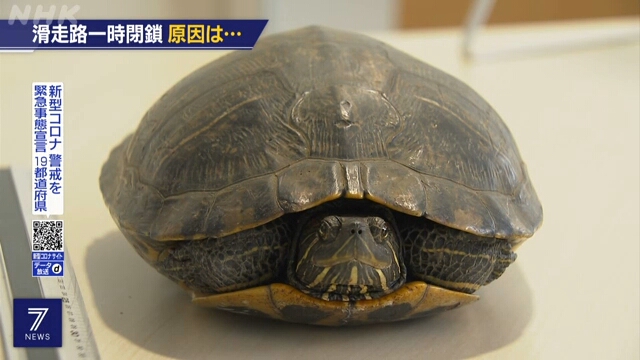
to show the tortoise in the incident
The rescued tortoise in the hands of the Narita Airport Corp. ©nhk.or.jp

We all know that a bird strike could potentially result in a catastrophic accident, with US Airways flight 1549 landing in the Hudson River being the most famous accident in recent years. Non-avian animals on the runway, however, could also cost millions of dollars in damages. According to a paper published by the United States Department of Agriculture back in 2005, the average number of the reported strikes of terrestrial animals was about 100 per year, and about 56% of the aircrafts were destroyed with most of the aircrafts being GA aircrafts. While the yearly average number of tortoise-strike was about 5, only 1 accident over the course of 13 years resulted in a destroyed aircraft. This leads to the next question, is it worth closing the runway of the busiest airport in Japan to save a sunbathing animal?

Coincidently, among the 5 delayed aircrafts was an Airbus 380 with a special livery of a Hawaiian-styled green turtle painted on its fuselage to endear the sacred green turtles in Honolulu. While it must have been an unforgettable moment to be delayed by a tortoise flying in a turtle-themed A380, it would cost the airlines thousands of dollars for even a 15-minute delay with all 4 of the engines running on the A380. The fuel burn of 4 engines running idle can cost up to USD1000 while operating the A380 and all four engines are typically turned on before take-off to warm up. Luckily, the flights were all departing traffic as it would cost up to USD10,000 for an A380 to execute a go-around. To execute a go-around, the aircraft will need to climb back up to a safe altitude and rejoin the approach to land, which would take around 15 minutes in the air with much higher fuel consumption rates.

So What If the Pilots Didn’t See the Tortoise?

The reported weather on the date indicates high visibility, if the pilots continued to take off without seeing an animal on the runway it could potentially lead to a devastating outcome. Due to the high thrust power setting at take-off, a large amount of air is sucked into the compressors of the engines. The suction generated can be strong enough to pull the animal into the engines and result in an engine fire, which typically means a total loss of an engine. The unit price of an engine ranges from around 9 million for the A320 to 13 million for the A380 and that takes no account other damages to the aircraft, airport, and most importantly, the safety of passengers.

You Might Also Like

Dense Fog Disrupts Flights Across North India
Air India: A Gateway to Bhuj’s Rich Heritage
The Realisation Of Covid-19 On Heathrow Airport’s Operations
British Airways Reveals Top 25 Travel Destinations for 2025
Bristol and Leeds Bradford Airport ranked Worst Airports in the UK
Share This Article
Facebook Twitter Email Copy Link
What’s your thoughts?
Love0
Sad0
Happy0
Angry0
ByLeo Cheung
Follow:
Aviation Reporter - Born and raised in Hong Kong, Leo has decided to pursue a career in aviation under the influence of the old Kai Tak Airport back in the days. With a degree in aviation, he has joint Travel Radar as an aviation reporter to diversify his views and apply professional knowledge to anyone who is interested in commercial aviation. He regularly contributes articles with 'inside the cockpit' knowledge.
Previous Article qatar-airways-set-to-expand-network Record Loss for Qatar Airways
Next Article smartwings european routes travel radar Smartwings To Add Routes Out Of New Canary Island Base
Leave a Comment

Leave a Reply Cancel reply

Your email address will not be published. Required fields are marked *


Stay Connected

FacebookLike
TwitterFollow
InstagramFollow
YoutubeSubscribe

Trending News

Image shows a small blue aircraft (Piper PA-28-151 Cherokee Warrior N405DS) grounded at Delaware Airpark during the day.
Fatal small plane crash in Washington
Aircraft Aviation Incidents & Accidents
Tecnam P2012 traveller aircraft flying through the clouds
Air Oceania resumes flights after fuel shortage halts operations
Aircraft Airlines Travel
Avianca Boeing 787-8 side view in flight
Avianca to relocate Fort Lauderdale operations to Terminal 4
Airlines Airports Manufacturing
Interior view of a compact, modern control room with two workstations positioned on either side of the frame, each equipped with a desk, keyboard, mouse and large computer monitor. The monitors display complex data visualisations, including weather radar patterns on the left screen and dense network maps of flight paths and activity across North America on the central wall display and the right screen. Two ergonomic office chairs with mesh backs are positioned in front of the desks. The walls and ceiling are lined with smooth, light grey panels, and recessed lighting creates an evenly illuminated, high‑tech environment focused on monitoring and analysis.
FAA awards $875M contract to Air Space Intelligence
Aviation Points & Loyalty Technology
Asiana Airlines Boeing 747 sitting on a runway with the sea in the background
Asiana Airlines to Leave Star Alliance
Airline Economics Airlines Aviation

Travel Radar is the leading digital hub for all things aviation and air-travel. Discover our latest aviation news, aviation data, insight and analysis.


Discover

  • Latest News
  • Subscribe
  • Weekly Digest
  • Contact Us
  • Privacy Policy
  • About Us
  • Advertising
  • Media Coverage
  • Press & Events
  • Join Our Team
  • Our Brands

Signup to our Newsletter!

And get the latest aviation news via our weekly news digest!

© Travel Radar Media Ltd. 2015-2026 | ISSN #2635-0696 | Trademark #UK00003579704
adbanner
Welcome to the TR Community!

Sign in to your account

Not a member? Sign Up