

By using this site, you agree to the Privacy Policy and Terms of Use.
Accept
Travel Radar - Aviation NewsTravel Radar - Aviation News
  • Breaking News
  • Aviation
    • Aircraft
    • Airlines
    • Airshow & Events
    • Careers
    • Manufacturing
  • Travel
    • Airports
    • Points & Loyalty
    • Technology
    • Trip Reviews
  • Newsletters
  • Aircraft for Sale
Reading: Flight trial with sustainable fuel hailed a success
Share
Sign In
Notification Show More
Font ResizerAa
Font ResizerAa
Travel Radar - Aviation NewsTravel Radar - Aviation News
  • Breaking News
  • Aviation
  • Travel
  • Newsletters
  • Aircraft for Sale
  • Breaking News
  • Aviation
    • Aircraft
    • Airlines
    • Airshow & Events
    • Careers
    • Manufacturing
  • Travel
    • Airports
    • Points & Loyalty
    • Technology
    • Trip Reviews
  • Newsletters
  • Aircraft for Sale
Signin Sign In
Follow US
Copyright © Travel Radar Media Ltd. 2025 | All Rights Reserved
Travel Radar - Aviation News > News > Aviation > Aircraft > Flight trial with sustainable fuel hailed a success
AircraftAviationManufacturing

Flight trial with sustainable fuel hailed a success

Kate Angel
Last updated: 12 July 2026 07:20
By Kate Angel
4 Min Read
Share
Image shows two Gulfstream 800 aircraft in a dark sky.
Gulfstream Aerospace high altitude Sustainable Aviation Fuel (SAF) flight test © Gulfstream Aerospace
SHARE

British aero-engine manufacturer Rolls-Royce has announced that its Pearl 700 engines successfully powered the first flight of the Gulfstream 800 ultra-long-range business jet, using 100% Sustainable Aviation Fuel (SAF). This positive news from the high-altitude flight test campaign is a major step forward toward SAF being fully certified for commercial aviation.
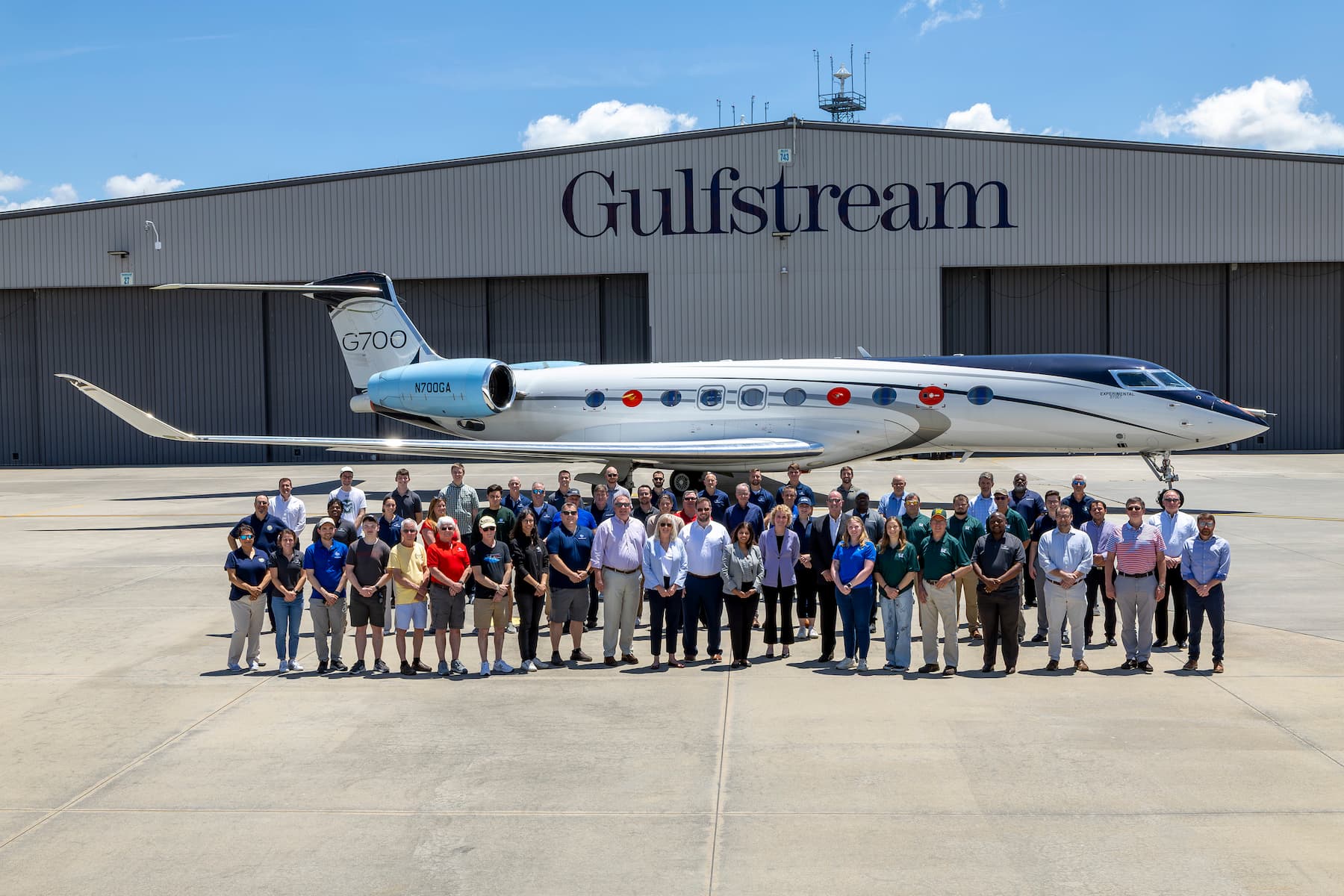
Image shows a silver Gulfstream 800 aircraft in front of a Gulfstream labelled hangar in the background, with a team of people nearby in the foreground.
Gulfstream Aerospace and Rolls-Royce have been trialling the use of sustainable aviation fuel (SAF) on Gulfstream 800 aircraft © Gulfstream Aerospace

Flight-test campaign

To undertake the experiment, a second modified Gulfstream 800 aircraft was converted into a “flying emissions measurement laboratory” and flew in close formation with the first at altitudes of up to 50,000 feet. This is higher than most commercial airlines (which typically fly at 25,000-40,000 feet) but is more typical for business aviation. Researchers were then able to capture precise measurements of particulate matter, and preliminary results suggested a “significant, measurable” reduction in emissions that contribute to contrail formation.

Rolls-Royce director of Research and Technology, Alan Newby, said:

“Sustainable Aviation Fuels in combination with compatible, ultra-efficient aero engines will not only play a vital role in decarbonising aviation but have also been shown to reduce certain non-CO2 emissions. The valuable insights we have gained from these latest tests at high altitudes, as well as the data from projects like QRITOS or ECLIF3, are driving real progress in understanding aviation’s non-CO2 climate impacts and potential mitigation options.”

Contrails in the sky causing an impact on the climate.
Contrails in the sky causing an impact on the climate © Dimitrio Lewis

Ongoing research

Concurrently, there is other research on the environmental effects of jet fuel carbon emissions, which more recently focuses on contrails. These are the white trails or streaks of cloud and even ice clouds (contrail cirrus) which form when the air at an altitude of 10-12 kilometres is so cold and damp that leftover aircraft exhaust fumes can freeze. This can be likened to autumnal conditions, when the warm air we breathe forms small fog droplets. To monitor the effects of contrails and subsequent changes in the chemical composition of the atmosphere, ten operational commercial aircraft worldwide are currently fitted with equipment from the In-service Aircraft for a Global Observing System (IAGOS).

The Gulfstream Aerospace and Rolls-Royce high-altitude flight test campaign also included input from other agencies, including the National Aeronautics and Space Administration (NASA) and the Federal Aviation Administration (FAA). The gathered data will inform future fuel standards and help develop strategies to ultimately reduce the environmental impact of air travel. The use of SAF has the potential to reduce net CO₂ emissions from lifestyle by about 80% (compared to conventional jet fuel).

The flight tests also demonstrated that all of Rolls-Royce’s Trent engines currently in production and its business aviation engines can operate with 100% SAF, meaning a future with cleaner fuel looks promising.

Do you feel enthused by this dawn of a new, cleaner air travel era? Or perhaps more sceptical about the cost? Let us know in the comments below.
You Might Also Like

London Southend Airport Launches Big Winter Schedule
Air Samarkand Confirms the Expansion of its Route Network
Qatar Airways Expands Saudi Network with New Hail Route
IATA Unveils 2026 Cargo and Ground Operations Update
Emirates debuts new premium Boeing 777 aircraft to further destinations
Share This Article
Facebook Twitter Email Copy Link
What’s your thoughts?
Love0
Sad0
Happy0
Angry0
Previous Article A detailed, side-angle view of a twin-engine Zimex Aviation ATR 72 regional airliner parked on a grey asphalt tarmac. The plane features a white forward fuselage with the blue text "ZIMEX" and a bright blue rear section and tail fin bearing the Swiss flag next to the registration "HB-ALM". Switzerland’s Zimex Aviation takes first DHC-6-300-G
Next Article A Wizz Air Airbus A320 is pictured on final approach with its landing gear deployed. The aircraft’s bright pink and purple livery stands out against a cloudless blue sky, highlighting the airline’s distinctive branding and modern narrowbody fleet. Wizz Air to open Spanish bases in 4Q27
Leave a Comment

Leave a Reply Cancel reply

Your email address will not be published. Required fields are marked *


Stay Connected

FacebookLike
TwitterFollow
InstagramFollow
YoutubeSubscribe

Trending News

An aircraft flying into a golden sunset, with fluffy clouds below.
Advanced weather intelligence introduced by Malaysia Airlines for stronger safety
Aircraft Airlines Aviation
HND entrance at sunset with a mountain in the background. cars are parked in front of the building which has lots of lights.
Tokyo to host FTE World Innovation Summit 2027
Airports Airshow & Events Technology
The front section of a British Airways plane on an airport taxiway against a pink and blue sky. The ground the plan is upon is dark grey concrete with yellow markings. The British Airways branding can be seen on the side of the plane's white body, and the engines are blue.
Investigation Launched After British Airways Flight Near Miss
Aircraft Aviation Incidents & Accidents
The picture depicts Bole International Airport in Addis Ababa, Ethiopia. There is a big hangar for aircraft shown with lettering saying 'Ethiopian Airlines' in a bright green font. Many Ethiopian aircraft are stationed in front of the hangar and waiting to be boarded.
The US express interest in Ethiopia’s new $12.5B airport
Airports Aviation Manufacturing
Boeing’s headquarters in Arlington, Virginia. A concrete and glass building is shown behind a clear lake and a small field surrounded by red trees.
Boeing Submit Deal to Major Engineering Union
Aircraft Airline Economics Aviation

Travel Radar is the leading digital hub for all things aviation and air-travel. Discover our latest aviation news, aviation data, insight and analysis.


Discover

  • Latest News
  • Subscribe
  • Weekly Digest
  • Contact Us
  • Privacy Policy
  • About Us
  • Advertising
  • Media Coverage
  • Press & Events
  • Join Our Team
  • Our Brands

Signup to our Newsletter!

And get the latest aviation news via our weekly news digest!

© Travel Radar Media Ltd. 2015-2026 | ISSN #2635-0696 | Trademark #UK00003579704
adbanner
Welcome to the TR Community!

Sign in to your account

Not a member? Sign Up