The cause of the small aircraft fatal crash that was carrying the Amarillo Pickleball Club members late last month has been released after concluding investigations. The plane crash that killed five people on their way to a pickleball tournament was found to be due to issues with its anti-icing system.

The Initial Crash
The crash occurred on Thursday, April 30, 2026, at approximately 11:03 p.m. The twin-engine Cessna 421C had a normal takeoff from River Falls Airport near Amarillo around 9:00 p.m.. The aircraft climbed to a cruising altitude of 17,400 feet and was in the air for nearly two hours. Just before 11:00 p.m., the plane abruptly dropped out of the sky, plunging at a rate exceeding 5,000 feet per minute. Radar contact was permanently lost minutes later.
The Amarillo Pickleball Club identified the five victims as Seren Wilson (19), Brooke Skypala (45), Stacy Hedrick (51), Justin “Glen” Appling (37), and Hayden Dillard (39).
The preliminary federal investigation report released by the National Transportation Safety Board (NTSB) on Friday, May 15, 2026, revealed that the plane suffered an in-flight structural breakup triggered by severe instrument icing.

The Investigation Findings
The report states that while en route to New Braunfels, pilot Justin “Glen” Appling reported to air traffic controllers that the plane’s pitot heat – the essential anti-icing system that prevents critical instruments from freezing – was inoperable. Without functional heating elements, the plane’s pitot tube (the external sensor used to measure flight parameters) iced over. The pilot radioed air traffic control requesting a lower altitude to warm back up and clear the ice accumulation. Controllers cleared the plane to descend from 8,000 feet down to 4,000 feet. The pilot acknowledged a radio frequency change at 10:59 p.m., which marked the final transmission from the aircraft.
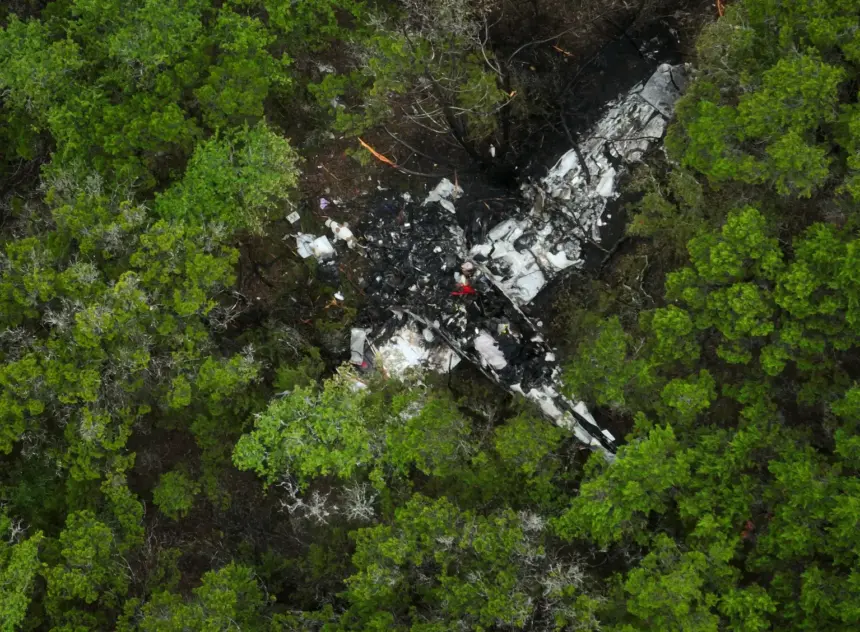
Flight tracking data shows that immediately after the last transmission, the plane made an abrupt sharp left turn, followed by a near 180-degree right turn, before entering an erratic, descending right spiral. The plane plunged rapidly at a rate exceeding 5,000 feet per minute. Aerodynamic stresses from the uncontrolled dive caused the aircraft to shatter and break apart midair before impacting a wooded area in Wimberley, Texas at 11:03 p.m.
According to the National Weather Service, it was mostly cloudy in the area just before the crash, and there was a thunderstorm two hours later. Pilot and flight instructor, Gene Robinson says that what stands out the most from the report is that the crash was “probably preventable”:
“Most of us would have said, wow, that weather for that night; we wouldn’t have gone up in an aircraft that size. We just wouldn’t have done it. That’s the main conclusion that I’ve gotten out of all my talks with all my other pilot friends, and the NTSB report confirms that.”
As this is a preliminary report, investigators are currently examining recovered avionics, engine components, weather radar data, and pilot training records. A final report determining the definitive probable cause can take up to a year or longer to be fully finalised.
Deepest sympathies go out to everyone affected by this tragic incident. To keep up-to-date on accidents like this, follow Travel Radar.