
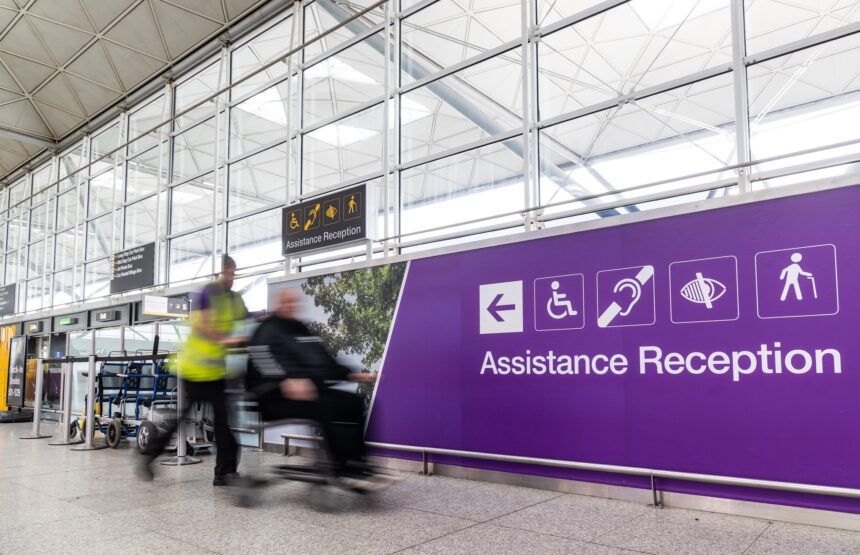
The UK’s Civil Aviation Authority (CAA) has published its annual Airport Accessibility Performance Report for 2025/26, assessing the quality of the assistance provided to passengers with disabilities and reduced mobility, at 28 UK airports. The report highlighted that demand for special assistance grew faster than overall passenger numbers, reaching record levels of 5.9 million passengers.
Positive investment and ratings
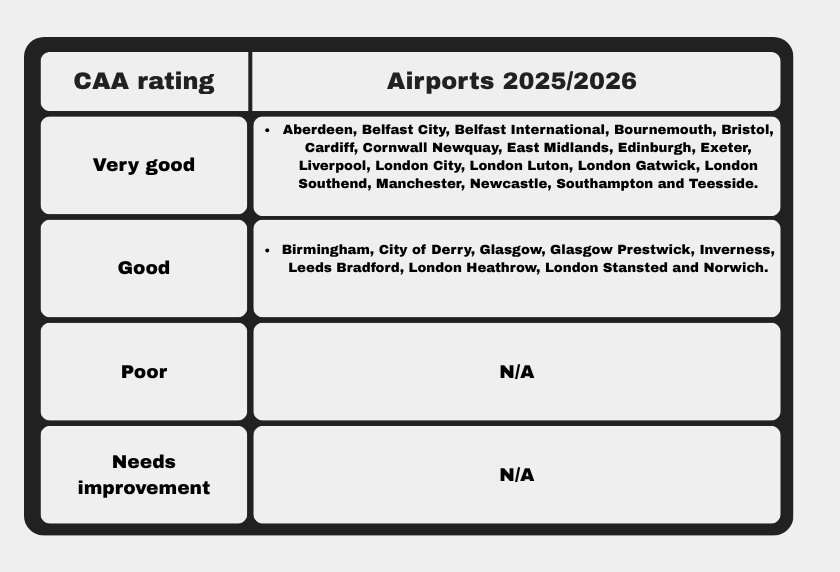
The CAA introduced its Airport Accessibility Performance Framework in 2014, setting out clear standards for airports for providing assistance to passengers with disabilities or reduced mobility. At that time, 13 airports were rated “poor” or “needs improvement”. In this latest report, it is highly encouraging that no UK airports received these less than positive ratings, highlighting the progress made from targeted investment into services, facilities and staff training.
The table below details the latest results. In last year’s report published in 2025, London Heathrow (LHR), Edinburgh (EDI) and Glasgow Prestwick (PIK) received “needs improvement” ratings. LHR and PIK have now achieved a “good rating”, whilst EDI has become “very good”, thanks to successfully reducing waiting times on arrival and performance in satisfaction surveys.
However, the CAA’s latest annual Aviation Consumer Survey found that general satisfaction among passengers with accessibility or disability needs was 82 percent, lower when compared with 88 per cent of all passengers. Fifty eight percent of disabled passengers had reported difficulties accessing or using airports, highlighting that there will always be room for improvement.
Civil Aviation Bill
Anna Bowles, Head of Consumer Protection at the CAA, said:
“The progress made in improving airport accessibility over the last decade is encouraging. Through our annual assessments, we have challenged airports to raise standards, increase transparency and focus on the needs of disabled passengers…We will consult on a revised version of the Framework later this year as we continue to challenge airports to improve further. The Civil Aviation Bill currently before Parliament would, if approved, give us additional enforcement powers to better hold airports to account for meeting the legal rights of passengers, including in relation to accessibility. This would in time help even further improve performance against our accessibility framework.”
The Civil Aviation Bill will support airspace modernisation (supporting redrawing of more efficient flight paths) and enhance safety standards for passengers (with measures to fast-track safety rules) across the UK, according to the government website. Airlines could also be fined if they do not provide compensation for cancelled flights or if they do not adequately support customers with flight disruptions or those with disabilities.
Do you agree with the CAA that these increased airport accessibility standards are encouraging? Let us know about any positive or negative experiences you may have had in the comments below.