By using this site, you agree to the Privacy Policy and Terms of Use.
Accept
Travel Radar - Aviation NewsTravel Radar - Aviation News
  • Breaking News
  • Aviation
    • Aircraft
    • Airlines
    • Airshow & Events
    • Careers
    • Manufacturing
  • Travel
    • Airports
    • Points & Loyalty
    • Technology
    • Trip Reviews
  • Newsletters
  • Aircraft for Sale
Reading: New York Times Investigation Reveals Pilot Error in Fatal Washington DC Helicoper Crash
Share
Sign In
Notification Show More
Font ResizerAa
Font ResizerAa
Travel Radar - Aviation NewsTravel Radar - Aviation News
  • Breaking News
  • Aviation
  • Travel
  • Newsletters
  • Aircraft for Sale
  • Breaking News
  • Aviation
    • Aircraft
    • Airlines
    • Airshow & Events
    • Careers
    • Manufacturing
  • Travel
    • Airports
    • Points & Loyalty
    • Technology
    • Trip Reviews
  • Newsletters
  • Aircraft for Sale
Signin Sign In
Follow US
Copyright © Travel Radar Media Ltd. 2025 | All Rights Reserved
Travel Radar - Aviation News > News > Aviation > Aircraft > New York Times Investigation Reveals Pilot Error in Fatal Washington DC Helicoper Crash
AircraftAirlinesBreaking NewsIncidents & Accidents

New York Times Investigation Reveals Pilot Error in Fatal Washington DC Helicoper Crash

Harley Bardell
Last updated: 30 April 2025 19:18
By Harley Bardell
4 Min Read
Share
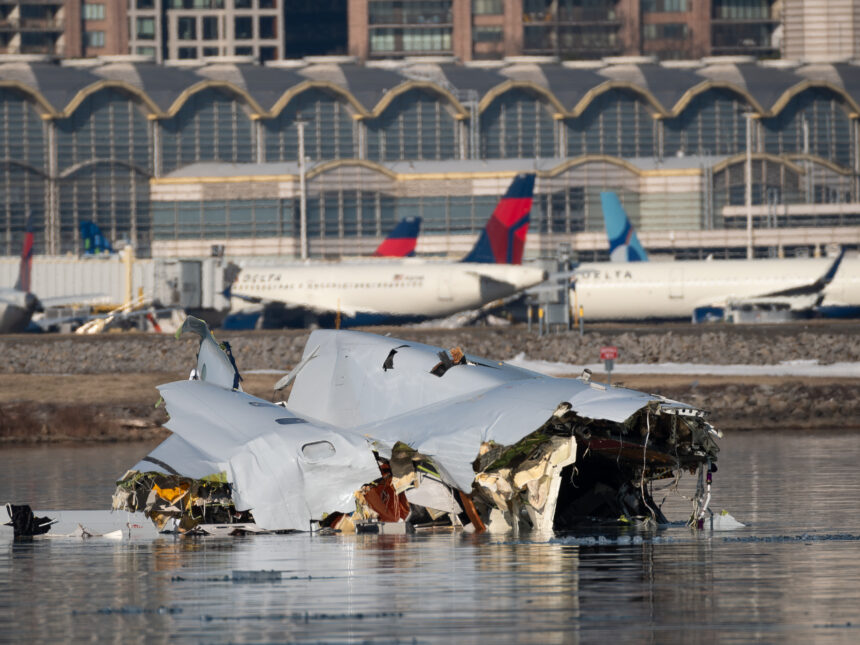
Aircraft wreckage from crash in Potomac River, taken on 30 January 2025
Wreckage from the crash in the Potomac River. © Petty Officer 1st Class Brandon Giles
SHARE

A New York Times investigation has revealed that the pilot of the Black Hawk helicopter which crashed into American Airlines flight AA5342, resulting in 67 deaths, failed to comply with a co-pilot’s instruction to change course, contributing to the collision.

A U.S. Army UH-60 Black Hawk helicopter assigned to the Colorado Army National Guard flies to perform a water drop while fighting the Black Forest Fire near Colorado Springs.
A U.S. Army UH-60 Black Hawk helicopter assigned to the Colorado Army National Guard. © Capt Darin Overstreet

About the Incident

The crash occurred during a U.S. Army Black Hawk training flight on January 29th, when the helicopter, authorised to fly at 200 feet (60.96 metres), climbed to around 300 feet (91.44 metres), directly into the flight path of the American Airlines regional jet flying from Wichita, Kansas. The CRJ jet was descending on its final approach for landing at Ronald Reagan Washington National Airport (DCA) with 64 people onboard, who all died in the collision. The crash took place over the Potomac River in Washington D.C., from which authorities recovered the wreckage and the victims’ bodies.

NTSB Chair Jennifer Homendy delivers opening remarks at the "Navigating Mental Health in Aviation" safety summit.
NTSB Chair Jennifer Homendy delivers opening remarks at the “Navigating Mental Health in Aviation” safety summit. © Leah Walton

Findings from the Investigation

The investigation carried out by the New York Times, in which public records were examined and more than 50 aviation experts and officials were interviewed, has revealed more information about the moments leading up to the crash, and the multiple factors which contributed to the deadliest U.S. aviation disaster for 16 years. Among other factors, one crucial failure which contributed to the incident was that of radio communication; some instructions from the controller went unheard as the helicopter crew pressed their microphones to speak, causing the communications to cut out and vital information to be missed by the crew.

Brig. Gen. Matthew Braman, director of aviation for the U.S. Army, said the following regarding the events:

I think what we’ll find in the end is there were multiple things that, had any one of them changed, it could have well changed the outcome of that evening.

He then deferred questions about the investigation to the National Transportation Safety Board (NTSB), the U.S. government’s investigative agency which determines the causes of transportation (including aviation) incidents and makes safety recommendations to improve transport safety. Despite this and the failure of several other safety measures, the error that was initially believed to be responsible for the helicopter crash was the helicopter’s altitude.

Following the NTSB’s initial investigations, its chairwoman, Jennifer Homendy, said the following:

…the existing separation distances between helicopter traffic operating on Route 4 and aircraft landing on runway 33 are insufficient and pose an intolerable risk to aviation safety by increasing the chances of a mid-air collision at DCA.

She also highlighted the fact that, during a three-year period, there were 85 recorded instances of less than 200 feet of vertical separation between a commercial flight and a helicopter. NTSB investigators will issue their final report outlining the causes of the crash by early 2026.

Were you personally affected by the events of the January 29th crash? Have you been following the New York Times investigation into the collision? Join the discussion in the comments.


You Might Also Like

Syria and the Saudi Flynas launch new airline, Flynas Syria
Air Canada and The Landline Company Extend Agreement for Luxury Land-Air Connections
IATA Appoints Sheldon Hee as Regional Vice President for Asia-Pacific
Private Aircraft crash in British Columbia kills pilot
Brussels Airlines Expands Three New A320neo Aircraft by 2026
Share This Article
Facebook Twitter Email Copy Link
What’s your thoughts?
Love0
Sad0
Happy0
Angry1
ByHarley Bardell
Follow:
Aviation Reporter - With a Master's Degree in Translation and Professional Language Skills from the University of Bath. He is based in Colchester, UK and has travelled extensively within Europe and beyond. He is fluent in Spanish and Italian in addition to his native English.
Previous Article The new Saudia airline lounge at Heathrow. New Saudia Airlines Lounge Opens at Heathrow
Next Article Aircraft between buildings. Aircraft Leasing Costs Remain High Amid Persistent Supply Chain Woes
Leave a Comment

Leave a Reply Cancel reply

Your email address will not be published. Required fields are marked *


Stay Connected

FacebookLike
TwitterFollow
InstagramFollow
YoutubeSubscribe

Trending News

A large pink, white and blue jetliner flying in a blue sky
Wizz Air reports drop in earnings amid Iran war
Airline Economics Airlines Aviation
A Boeing B-52 Stratofortress on runway before take off
US Air Force B-52 bomber crashes shortly after take-off from California base
Aircraft Breaking News Incidents & Accidents
Delta Air Lines Boeing 767-3P6/ER (reg. N1501P, cn 24983/334) taking off at Stuttgart Airport (STR/EDDS) taken on 7 February 2011, 11:06:32
Starlink vs. Amazon: Airlines race to upgrade in-flight Wi-Fi, as new ‘connectivity arms race’ takes shape
Airline Economics Aviation Technology
A Malaysia airlines Airbus A330 jet taking off from an airport runway in front of a field of grass.
Far Eastern Travel from the UK Grows Rapidly
Aviation Route Development Travel
An aerial shot of Frankfurt International Airport. Surrounding trees and greenery can be seen either side of the runway and buildings.
Frankfurt Added to Kuehne+Nagel Transatlantic Rotation
Airline Economics Airlines Route Development

Travel Radar is the leading digital hub for all things aviation and air-travel. Discover our latest aviation news, aviation data, insight and analysis.


Discover

  • Latest News
  • Subscribe
  • Weekly Digest
  • Contact Us
  • Privacy Policy
  • About Us
  • Advertising
  • Media Coverage
  • Press & Events
  • Join Our Team
  • Our Brands

Signup to our Newsletter!

And get the latest aviation news via our weekly news digest!

© Travel Radar Media Ltd. 2015-2026 | ISSN #2635-0696 | Trademark #UK00003579704
adbanner
Welcome to the TR Community!

Sign in to your account

Not a member? Sign Up