By using this site, you agree to the Privacy Policy and Terms of Use.
Accept
Travel Radar - Aviation NewsTravel Radar - Aviation News
  • Breaking News
  • Aviation
    • Aircraft
    • Airlines
    • Airshow & Events
    • Careers
    • Manufacturing
  • Travel
    • Airports
    • Points & Loyalty
    • Technology
    • Trip Reviews
  • Newsletters
  • Aircraft for Sale
Reading: Air Cargo: the Differences between Traditional Airlines and Integrated Carriers
Share
Sign In
Notification Show More
Font ResizerAa
Font ResizerAa
Travel Radar - Aviation NewsTravel Radar - Aviation News
  • Breaking News
  • Aviation
  • Travel
  • Newsletters
  • Aircraft for Sale
  • Breaking News
  • Aviation
    • Aircraft
    • Airlines
    • Airshow & Events
    • Careers
    • Manufacturing
  • Travel
    • Airports
    • Points & Loyalty
    • Technology
    • Trip Reviews
  • Newsletters
  • Aircraft for Sale
Signin Sign In
Follow US
Copyright © Travel Radar Media Ltd. 2025 | All Rights Reserved
Travel Radar - Aviation News > News > Air Cargo: the Differences between Traditional Airlines and Integrated Carriers

Air Cargo: the Differences between Traditional Airlines and Integrated Carriers

Michael Cheng
Last updated: 23 April 2021 19:45
By Michael Cheng
3 Min Read
Share
Finnair Cargo Loading
Finnair Cargo Loading © Finnair
SHARE

Air cargo has a massive market share in the logistics sector. For the past 2-3 decades, traditional airlines and integrated carriers have significantly impacted the cargo industry. Here, we explain a few differences between conventional airlines and integrated carriers.

Summary
Service scaleSupporting facilityReal-time trackingLogistics networkReliability and quality assurance

Service scale

Air cargo shipment considerations begin with the service scale. Traditional airlines offer cargo handling between airports and shippers can directly take their shipment to/collect it from airlines or use an assigned cargo handler. However, integrated carriers commonly provide a “door to door service” with the support of their transportation network via air, land and sea.

Supporting facility

Facilities also affect the process of selecting cargo providers. Airlines cooperate with local cargo terminal operators to save costs in infrastructure and operations. Comparatively, integrated carriers offer mature infrastructure and their own cargo hubs and distribution centres to facilitate the requirement of “door-to-door” and customised services. As an example, DHL Express has successfully demonstrated seamless connectivity with its own Central Asia hub warehouse and distribution centres across Hong Kong.

Real-time tracking

Accessibility is critical for maintaining good logistics services. Using traditional airlines provides operational flexibility and reduced costs. However, integrated carriers implement checkpoint systems that provide real-time monitoring of each collection stage’s consignment and records. A reliable tracking system facilitates excellent communication with the consignee to manage availability and readiness.
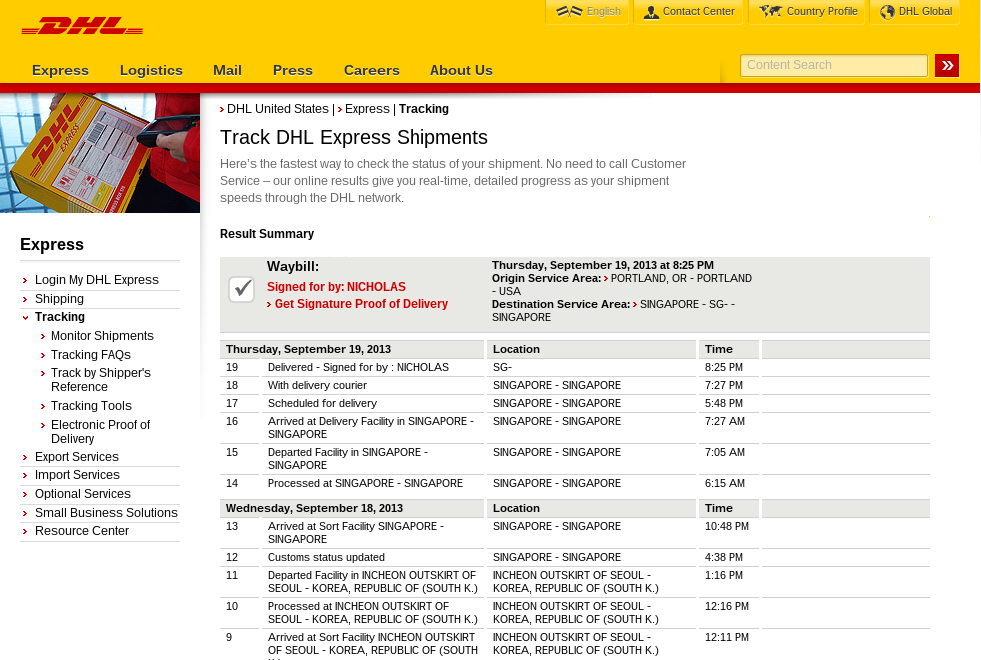
Shipment is trackable
The shipment is trackable during each stage of the process. (Source: DHL Express)

Logistics network

Network coverage can be attractive for consumers when choosing traditional airlines. Shipments may require transfers at more than one station if the destination is out of the airline’s network, which will eventually limit and potentially delay the delivery. Integrated carriers can purchase other airlines’ cargo bay capacity to fulfill these demands and maximise the efficiency.


Global network for cargo airlines (Source: NCA - Nippon Cargo Airlines)
A global cargo airline network (Source: NCA – Nippon Cargo Airlines)
FedEx flight network
FedEx flight network (Source: FEDEX)

Reliability and quality assurance

Air cargo is one of the fastest and most dependable means of moving various types of cargo from one place to another, anywhere in the world. This is especially important for time-sensitive and special shipments. A comprehensive, organised and certified handler will provide adequate quality management of the handling process. However, due to resources, some airlines may not be certified for endorsement, eliminating certain cargo types for the shipment. Comparably, integrated carriers would usually apply and get certified for special cargo endorsements. These include IATA’s CEIV certifications which cover fresh goods, live animals and pharma. These international certifications certify that the shipments comply with the latest industry guidance, providing a stable and reliable service for customers.

Choosing the best method for shipping can sometimes be tricky, especially when efficiency and costs are put into consideration.


You Might Also Like

Exploring the Convenience of One-Way Car Rentals: What You Need to Know
Ryanair Delivers ‘Exciting Reinstated’ Route in Bologna 2025 Winter Schedule
Stansted Airport: Top Three Thirty Year Status
Ryanair Removes Face Mask Requirements
Boeing Delay Delivery of 777X, and Axe 767F Entirely, as Strike Continues
Share This Article
Facebook Twitter Email Copy Link
What’s your thoughts?
Love0
Sad0
Happy0
Angry0
ByMichael Cheng
Follow:
Aviation Reporter - Based in Hong Kong, Michael is an Aviation Journalist here at Travel Radar, covering industry insights across Asia as well as international technical development within the industry. With the solid experience in airline ground operations, Michael is currently a Quality Assurance and Compliance Monitoring Officer with a large ground-operations company. In his spare time, Michael is an avid flight-simulation fan, serving in a senior marketing role for a large multiplayer server. Alongside this, he makes regular appearances at workshops and conferences across the aviation industry
Previous Article Photo by Will Waters on Unsplash Cirium: Australia and New Zealand on the Road to Capacity Recovery
Next Article Manchester Airport Prepares for Take Off
Leave a Comment

Leave a Reply Cancel reply

Your email address will not be published. Required fields are marked *


Stay Connected

FacebookLike
TwitterFollow
InstagramFollow
YoutubeSubscribe

Trending News

An Air France Boeing 777-300ER aircraft shown on its right-hand side
Air France-KLM Secures €1 Billion Credit Facility to Strengthen Financial Flexibility
Aviation Travel Radar
A line of EES kiosks with a large sign that instructs passengers of the registration process.
EU’s EES Cause Huge Queues and Double Wait Time
Airports Aviation Technology
An Air Charter Scotland Embraer Legacy 650 aircraft shown on its right-hand side
Air Charter Scotland Adds Year-Round Wick–Glasgow Route with New PSO Contract
Aviation Route Development Travel
The logos of three airline alliances: Star alliance, SkyTeam, and Oneworld, superimposed on a picture of a plane flying upwards in front of a blue sky. There is a tree to the left of the image, and text saying “How Do Airline Alliances Impact Travellers?”
How Have Airline Alliances Changed Your Flying Experience?
Airline Economics Airlines Aviation
A Flyadeal aircraft shown on the right-hand side, featuring a clear blue sky background
Flyadeal Adds Mumbai as Second Indian Destination with New Riyadh Route
Airlines Route Development Travel

Travel Radar is the leading digital hub for all things aviation and air-travel. Discover our latest aviation news, aviation data, insight and analysis.


Discover

  • Latest News
  • Subscribe
  • Weekly Digest
  • Contact Us
  • Privacy Policy
  • About Us
  • Advertising
  • Media Coverage
  • Press & Events
  • Join Our Team
  • Our Brands

Signup to our Newsletter!

And get the latest aviation news via our weekly news digest!

© Travel Radar Media Ltd. 2015-2026 | ISSN #2635-0696 | Trademark #UK00003579704
adbanner
Welcome to the TR Community!

Sign in to your account

Not a member? Sign Up