By using this site, you agree to the Privacy Policy and Terms of Use.
Accept
Travel Radar - Aviation NewsTravel Radar - Aviation News
  • Breaking News
  • Aviation
    • Aircraft
    • Airlines
    • Airshow & Events
    • Careers
    • Manufacturing
  • Travel
    • Airports
    • Points & Loyalty
    • Technology
    • Trip Reviews
  • Newsletters
  • Aircraft for Sale
Reading: How to resurface one of the busiest runways in the world
Share
Sign In
Notification Show More
Font ResizerAa
Font ResizerAa
Travel Radar - Aviation NewsTravel Radar - Aviation News
  • Breaking News
  • Aviation
  • Travel
  • Newsletters
  • Aircraft for Sale
  • Breaking News
  • Aviation
    • Aircraft
    • Airlines
    • Airshow & Events
    • Careers
    • Manufacturing
  • Travel
    • Airports
    • Points & Loyalty
    • Technology
    • Trip Reviews
  • Newsletters
  • Aircraft for Sale
Signin Sign In
Follow US
Copyright © Travel Radar Media Ltd. 2025 | All Rights Reserved
Travel Radar - Aviation News > News > Travel > Airports > How to resurface one of the busiest runways in the world
AirportsDid You Know

How to resurface one of the busiest runways in the world

Kate Angel
Last updated: 16 October 2026 20:08
By Kate Angel
5 Min Read
Share
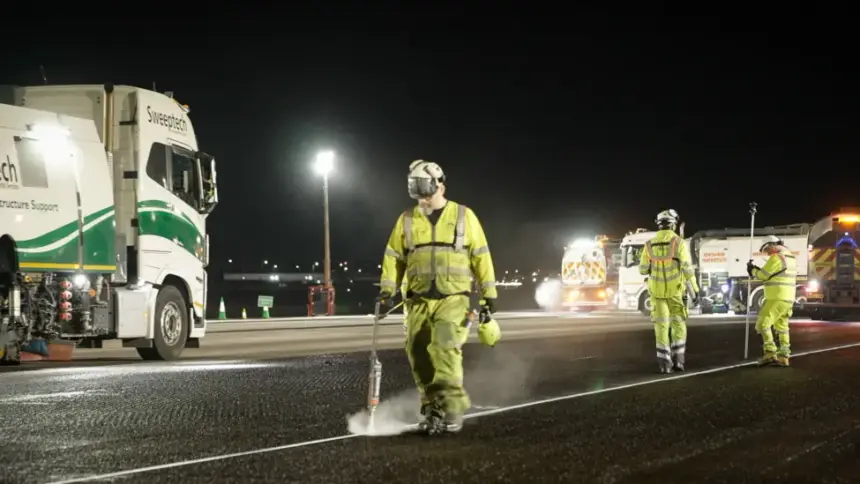
Image shows a team of maintenance workers in yellow suits and safety equipment spraying the tarmac at well-lit Heathrow Airport at night with a truck in the background
Specialist workers mark and check the runway at Heathrow Airport © Heathrow Airport via BBC
SHARE

When a road needs to be resurfaced, it is cordoned off with access restricted. However, resurfacing an entire airport runway is a much more complicated engineering affair, with challenging logistics. The Northern runway at London Heathrow (LHR) is currently being replaced during the night, around the 1,300 combined take-offs and landings, in order to remove embedded aircraft tyre rubber. The project will be completed over three months, by 230 specialist workers, using around 130 different maintenance vehicles.
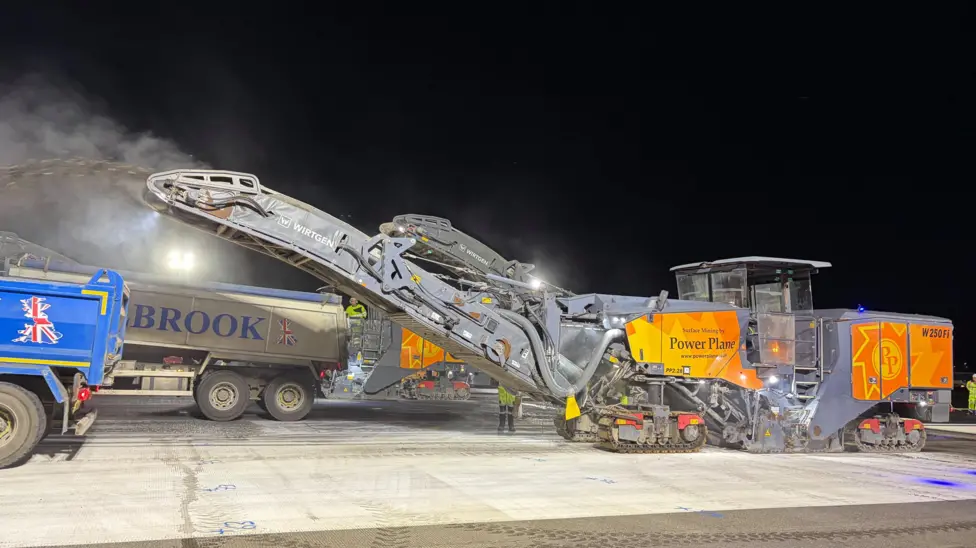
Image shows a large milling machine and other vehicles on the runway at Heathrow Airport at night
A milling machine is used to remove parts of the runway © Heathrow Airport via BBC

How do they do that?

At 10.45 p.m, a waiting convoy of vehicles wait for the last aircraft to leave LHR. They will have a five hour window to set up a construction site, dig up and resurface about 75 metres (246ft) of a runway section, before incoming aircraft are due to land from abroad.

Just like on a road, workers set up cones and measure and mark out lines with spray paint. The old surface is removed by a milling machine (and will later be recycled by the construction industry or used to make local roads). The surface is then prepared for new asphalt which needs to be ready with an exact type and thickness (and is more difficult to lay than highways). This asphalt has already been mixed in plants on-site and 25 wagons transport the lower layer for laying. Then the wagons collect the next 500 tonnes for laying the surface course material. This is all then compacted and sealed and once it is cooled to the right temperature, new paint markings can be applied. As most aircraft weigh around 200 tonnes and are travelling about 140mph when landing, the material has to be able to withstand incredible pressure.

The team need to be ready to leave at 04:30 a.m. in order for the operations team to carry out a foreign object debris safety inspection. The runway is then handed back to air traffic control by 05:45 a.m, to enable them to vector in the first aircraft at 6 a.m.
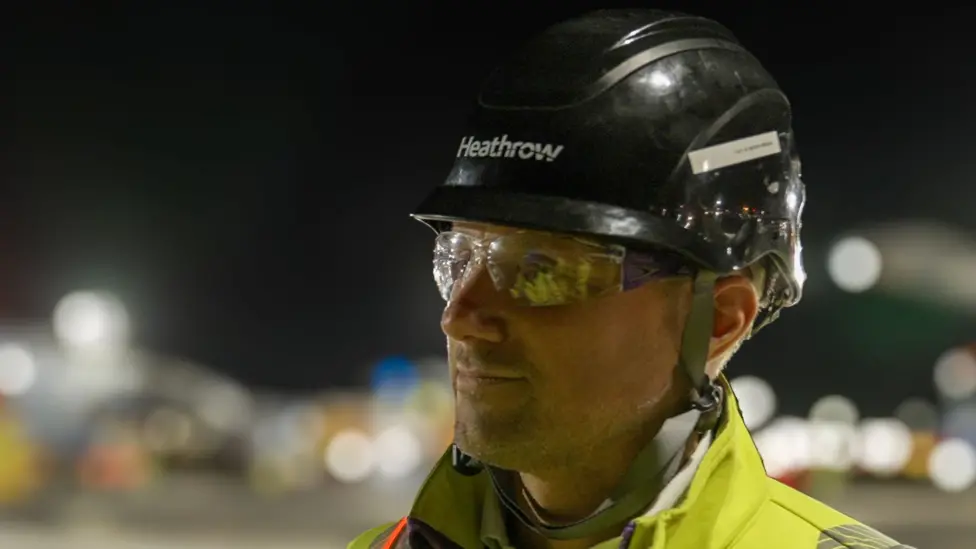
Image shows a close-up of Alistair Awcock, Heathrow's infrastructure delivery and strategic planning director at night wearing a safety helmet and equipment
Alistair Awcock, Heathrow’s infrastructure delivery and strategic planning director says the runways are the airport’s most critical asset © Heathrow Airport via BBC

Critical asset

Alistair Awcock, LHR’s infrastructure delivery and strategic planning director told the BBC:

“It’s a scheme that we undertake about every sort of 10-12 years, based on the condition of the runway. Obviously, our runways are our most critical asset, it is the thing that keeps our business operating. So, we’re willing to invest to make sure that this stays operational all year round. It is a big job.”

The delivery project manager, Gawaine Yates emphasised how the skilled work is practised, trialled, improved and fine-tuned. A recovery truck is on site every night, in case of the “rare occurrence” where equipment breaks down and needs to be removed from the runway. He adds:

“The public have not known any dramas from here, because we’re dealing with it on the night…fingers crossed, we haven’t had any operational issues. The implications of not handing this runway to our operation is not just an impact to Heathrow but would impact the whole of the UK airspace.”

At the end of the project, the specialist teams will replaced around 200,000 tonnes of asphalt. According to website The measure of things, that is more than eight times heavier than the United States’ Statue of Liberty, or about 2,000 blue whales. That is no mean feat, considering this essential maintenance work occurs without disrupting the operations of the United Kingdom’s largest and busiest airport.

Are you impressed by this high-pressure maintenance work that happens overnight at LHR? Let us know in the comments below.
You Might Also Like

Gatwick Gridlocked After Norse Flight Aborts Take-Off at 138mph
SAS Tops Sustainability Rankings in Denmark and Sweden
Jet2 Expands “Sunshine Favourite” Greek Programme at Bristol Airport for Summer 2026
Avelo Airlines to Become First Commercial Carrier at McKinney Airport
Alaska Airlines Reveals First Looks of New Lounge in Honolulu
Share This Article
Facebook Twitter Email Copy Link
What’s your thoughts?
Love0
Sad0
Happy0
Angry0
Previous Article Image of the Delta Airbus A350 wingtip stuck in the Air Canada Boeing 777 right stabiliser. Delta Air Lines’ Aircraft Wingtip Stuck in Air Canada’s Aircraft Tail
Next Article An AirAsia Airbus A320-216(WL) on the ground at Kota Kinabalu International Airport. AirAsia Discusses Government Funding Support, Sources Say
Leave a Comment

Leave a Reply Cancel reply

Your email address will not be published. Required fields are marked *


Stay Connected

FacebookLike
TwitterFollow
InstagramFollow
YoutubeSubscribe

Trending News

Photograph depicting Emirates' Boeing 777 flying above the clouds.
Emirates opens new Tokyo travel store
Airlines Aviation Travel
Photograph depicting the exterior of the American Airlines Boeing 787-9 on the runway.
American Airlines brings Starlink to mainline aircraft
Airlines Aviation Technology
A Ryanair Boeing 737 in mid-flight, blue sky.
Ryanair Announces Record Kraków Winter 2026 Schedule
Airlines Route Development
An AirAsia Airbus A320-216(WL) on the ground at Kota Kinabalu International Airport.
AirAsia Discusses Government Funding Support, Sources Say
Airline Economics Airlines Aviation
Image of the Delta Airbus A350 wingtip stuck in the Air Canada Boeing 777 right stabiliser.
Delta Air Lines’ Aircraft Wingtip Stuck in Air Canada’s Aircraft Tail
Aircraft Airlines Incidents & Accidents

Travel Radar is the leading digital hub for all things aviation and air-travel. Discover our latest aviation news, aviation data, insight and analysis.


Discover

  • Latest News
  • Subscribe
  • Weekly Digest
  • Contact Us
  • Privacy Policy
  • About Us
  • Advertising
  • Media Coverage
  • Press & Events
  • Join Our Team
  • Our Brands

Signup to our Newsletter!

And get the latest aviation news via our weekly news digest!

© Travel Radar Media Ltd. 2015-2026 | ISSN #2635-0696 | Trademark #UK00003579704
adbanner
Welcome to the TR Community!

Sign in to your account

Not a member? Sign Up