
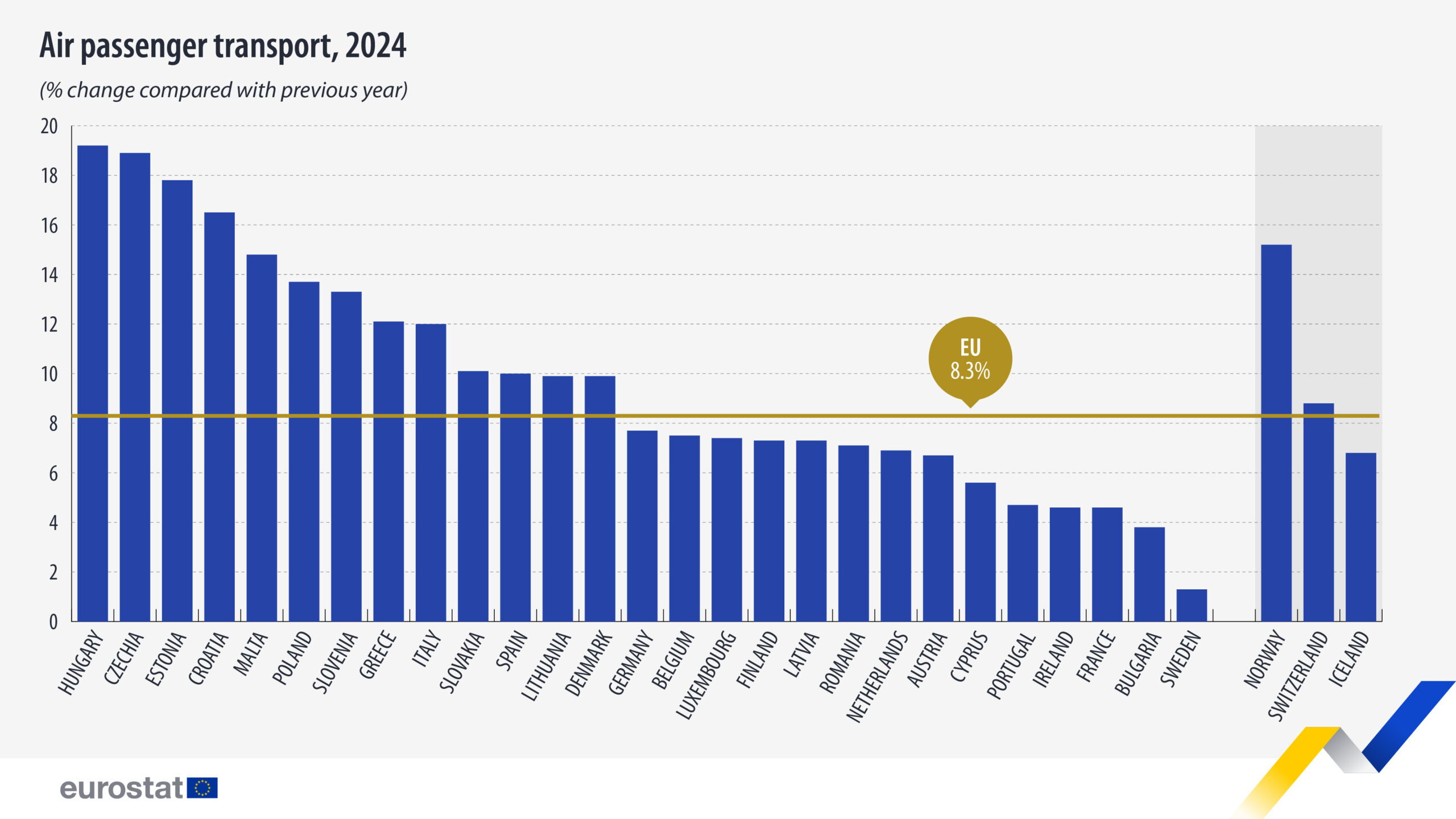
The number of passengers travelling by air in the European Union (EU) reached 1.1 billion in 2024, beating the 1 billion in 2019. According to newly released Eurostat data, this marks an increase of 8.3% compared to 2023, which registered 973 million air travellers.
The EU agency reported that all Member States contributed to the surge, with the most significant increases in Hungary (+19.2%), Czechia (+18.9%), and Estonia (+17.8%). The lowest increases were in Sweden (+1.3%) and Bulgaria (+3.8%).
The growth was registered in all months compared to 2023 across the bloc, with the largest increase in February (+13%) and the lowest in July and October (+6.3%).
The busiest airport was Paris Charles de Gaulle (CDG) in France, with 70.3 million passengers (+4.3%). The highest increase was at Rome-Fiumicino International Airport (FCO), which ranked 6th with 48.7 million passengers but saw a rise of 20.8% from 2023.
Travel between the EU and external countries
Air transport to and from countries outside the EU accounted for 49.3% of all air passenger transport, ahead of intra-EU transport (36.4%) – each registered a gain of 0.3 and 0.4 percentage points, respectively. Domestic travel represented 14.3% of the total, down 0.7 percentage points from 2023.
European countries outside the bloc were the main origin or destination for flight passengers to and from the EU, accounting for 56.7% of total extra-EU air transport.
Not just people
Air freight and mail transport in the EU also registered an increase of 8.7% in 2024 compared with 2023, with over 14.3 million tonnes.
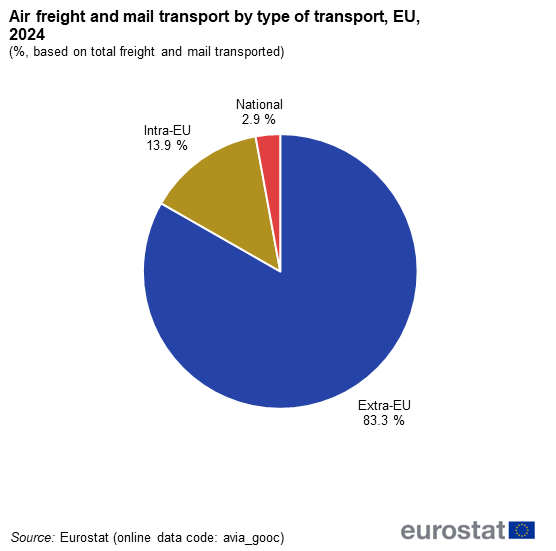
The rise was driven by a 10.8% growth in extra-EU transport, which accounted for 83.3% of the total air freight and mail transport in the bloc.
Frankfurt International Airport (FRA) was the main EU airport for freight and mail, handling 2 million tonnes.
Will this upward trend continue once 2025 has drawn to a close? Share your thoughts in the comments below.