By using this site, you agree to the Privacy Policy and Terms of Use.
Accept
Travel Radar - Aviation NewsTravel Radar - Aviation News
  • Breaking News
  • Aviation
    • Aircraft
    • Airlines
    • Airshow & Events
    • Careers
    • Manufacturing
  • Travel
    • Airports
    • Points & Loyalty
    • Technology
    • Trip Reviews
  • Newsletters
  • Aircraft for Sale
Reading: Survival of the Fittest; Commercial Aviation in Crisis
Share
Sign In
Notification Show More
Font ResizerAa
Font ResizerAa
Travel Radar - Aviation NewsTravel Radar - Aviation News
  • Breaking News
  • Aviation
  • Travel
  • Newsletters
  • Aircraft for Sale
  • Breaking News
  • Aviation
    • Aircraft
    • Airlines
    • Airshow & Events
    • Careers
    • Manufacturing
  • Travel
    • Airports
    • Points & Loyalty
    • Technology
    • Trip Reviews
  • Newsletters
  • Aircraft for Sale
Signin Sign In
Follow US
Copyright © Travel Radar Media Ltd. 2025 | All Rights Reserved
Travel Radar - Aviation News > News > Survival of the Fittest; Commercial Aviation in Crisis

Survival of the Fittest; Commercial Aviation in Crisis

Travel Radar Staff
Last updated: 16 March 2020 13:56
By Travel Radar Staff
5 Min Read
Share
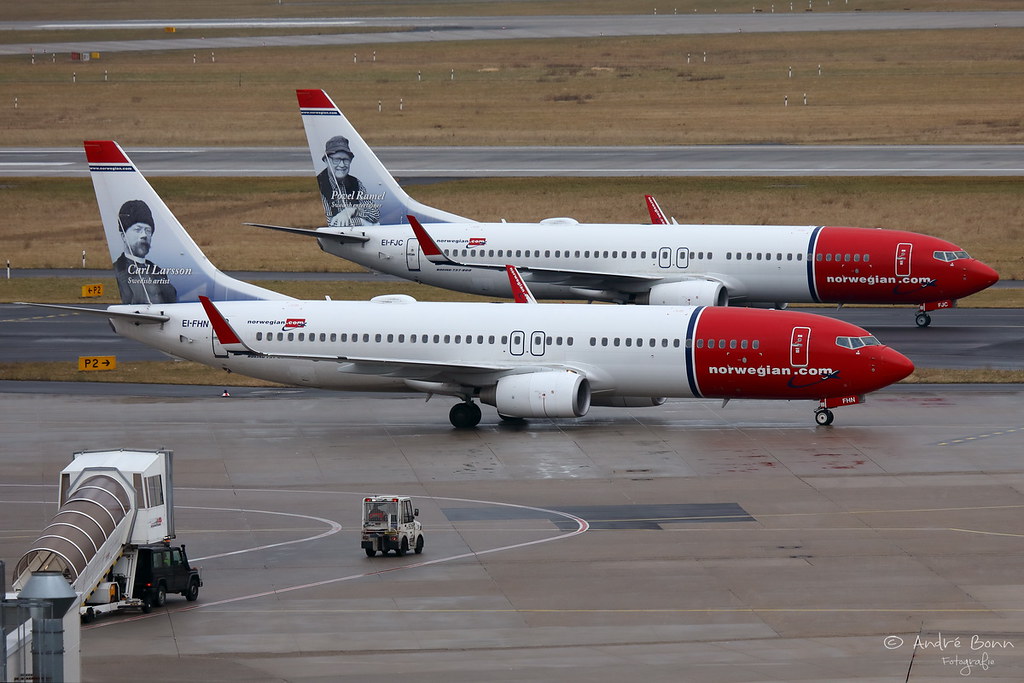
Norwegian in Dire Straits ©Flickr Commons
SHARE

The impact of the spread of coronavirus has four levels of impact in relation to the airline business. We’ll try and make sense of the flood of news in the last few days.

Firstly, many countries have (or are on the brink of) shutting their borders, and so severely restricting air transport. Amongst others, Italy, Germany, Denmark, and Spain in Europe have done so in whole or in part. The US has postponed flights from Europe for all but US citizens, the UK has reciprocated. India has suspended all tourist visas and e-visas granted on or before 11th March. The state of Qatar has announced similar restrictions. In an ironic twist of fate, China has placed all those arriving at Beijing into compulsory quarantine. Even South Africa has forbidden entry to those from severely affected countries.
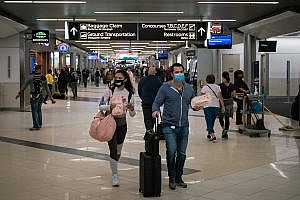
Passengers at ATL ©Flickr Commons

Secondly, the response from airlines is obvious if catastrophic. Lufthansa has cut flights by 50% in April and may ultimately cut by 90%. It may sell some of its aircraft. Air France has grounded its thirsty A380s. Emirates will ground many of its own. Delta says it may have to lose 40% of its international schedules. Korean has cut 80%, and Cathay Pacific by 65% in March and April. In a devastating reduction in service, SAS of Scandinavia has been obliged to put most of its operations on hold, citing ‘non-existent’ demand. SAS is reported to be laying off 90% of its employees. Ryanair has announced that it will reduce seat capacity by up to 80% and doesn’t rule out the possibility of grounding the entire fleet.
Ryanair cuts capacity by 80% ©Flickr Commons

Thirdly, as a consequence, shares of airlines on global stock markets have fallen sharply-potentially the largest collective drop in history. Some examples: on the London Exchange today (where the FTSE has declined 8% at mid-morning Monday) Ryanair has lost 19% on the day, American by 16%, EasyJet by 24%, Wizz Air by 45% and the mighty IAG–parent of British and Iberia—by 23%. The Chief Executive of British Airways, Alex Cruz in a memo to staff entitled ‘The Survival of British Airways’ spoke of ‘a crisis of global proportions like no other we have known.’ Today, Virgin Atlantic is requesting emergency financial measures from the British government for UK airlines and Lufthansa is in conversation with European governments.

Fourthly, where does this leave the business? The hope is that passenger numbers will rebound after a few months of chaos, revert to normal and growth will resume. This was the pattern after the terrorist attacks in the US in September 2001, the global crisis of 2007-09, and the trend occurring in China at the moment where new infections approach zero. But China is a special case, with a massive domestic market.

The aviation consultancy CAPA has said that most airlines in the world will be technically bankrupt by the end of May. If the period of chaos lasts longer than a few more months—perhaps beyond June, those carriers who were already in difficulty may shut down for good; candidates might include Norwegian, Korean, Alitalia, Air India, and American.
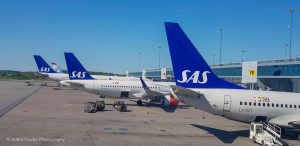
SAS have suspended all operations indefinitely | (c) Adam Fowler

In 1859, Charles Darwin wrote ‘On the Origin of Species’ where he put forward the theory of ‘survival of the fittest’; that organisms that would thrive are not necessarily the strongest but those that are most adaptable to their environment. Darwin’s theory now seems to be relevant to the aviation industry, not just for carriers, but for all those businesses that are dependent on it.
You Might Also Like

More Regional Flights Scheduled to Cater to Expo 2025 Demands
Major Aircraft Factory Forced to Close
ANA Launches Hello Blue Sale: Affordable Flights from Australia to Japan
Skiing in Scandinavia: Norway as top choice for UK winter travellers
Parallel Runway Departure Near Miss in Houston
Share This Article
Facebook Twitter Email Copy Link
What’s your thoughts?
Love0
Sad0
Happy0
Angry0
ByTravel Radar Staff
Follow:
Articles from guest contributors wishing to remain anonymous are credited to this account. Want to contribute to Travel Radar either in-name, or anonymously? Get in touch: [email protected]
Previous Article Scandinavian Airlines Stops Operations Due To “Non-Existent” Demand
Next Article Virgin A350-1000 ©flights.com.kw Virgin Atlantic Asks Staff to Take Unpaid Leave
4 Comments

Leave a Reply Cancel reply

Your email address will not be published. Required fields are marked *


Stay Connected

FacebookLike
TwitterFollow
InstagramFollow
YoutubeSubscribe

Trending News

Photo shows Owain Davies
Swiss Alps Crash Kills Three People
Aviation Incidents & Accidents
The photo shows a Qantas aircraft mid-flight, with a blue sky as the background.
Qantas Ground Workers Set to Strike Over Working Conditions
Airlines Aviation Travel
A white and blue Boeing 737 MAX jet flying over a layer of cloud.
Boeing Unable to Stabilise 737 MAX Production
Aircraft Aviation Manufacturing
A red and white AirAsia jet flying over an ocean. A few clouds can be seen below the jet.
AirAsia CEO Confident in Airline’s Sustainability
Airline Economics Airlines Aviation
A Jet2 aircraft is pictured on a runway or taxiway at an airport. The aircraft is pictured from the front at an angle, with the nose to the centre right and the tail to the centre left. The plane is white, with a light blue tail with an orange and yellow sun logo on it, and 'Jet2holidays' branding along the lower front of the aircraft. In the foreground, tarmac separated by grass verges can be seen. In the middle distance, there is a row of trees and shrubbery, before a strip of grey blue sky in the background.
Jet2 Aircraft Diverted Following ‘Medical Emergency’ Onboard
Aircraft Airports Aviation Incidents & Accidents

Travel Radar is the leading digital hub for all things aviation and air-travel. Discover our latest aviation news, aviation data, insight and analysis.


Discover

  • Latest News
  • Subscribe
  • Weekly Digest
  • Contact Us
  • Privacy Policy
  • About Us
  • Advertising
  • Media Coverage
  • Press & Events
  • Join Our Team
  • Our Brands

Signup to our Newsletter!

And get the latest aviation news via our weekly news digest!

© Travel Radar Media Ltd. 2015-2026 | ISSN #2635-0696 | Trademark #UK00003579704
adbanner
Welcome to the TR Community!

Sign in to your account

Not a member? Sign Up