
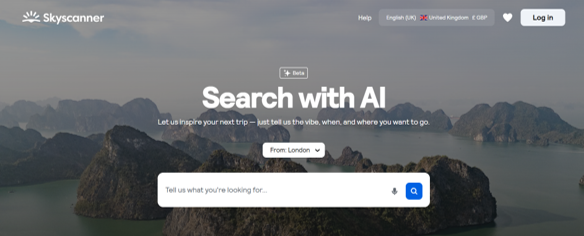
Last month, travel search engine and flight comparison site Skyscanner published its annual Travel Trends 2027 report highlighting an increase in travellers using Artificial Intelligence (AI) during their planning process. The company has now announced a restructure affecting 10% of its workforce, 150 jobs, in order to respond more quickly to industry changes and simplify operations.
Travel and role of search rapidly changing
Skyscanner was founded in 2003 and is a Scottish company with headquarters in Edinburgh. Ten years ago, it became a subsidiary of the Trip.com Group, based in China. In a statement, a Skyscanner spokesperson confirmed the proposed organisational changes were to build for the future and increase velocity, whilst thanking affected staff for their contribution to the company:
“The proposals aim to clarify priorities and decision-making, remove barriers between teams, give people more autonomy and focus on the opportunities ahead. As a result, approximately 10% of our workforce will be affected by the proposals, and we are engaging with employees or their appointed union representatives in line with local processes.”
The affected Skyscanner teams are likely to be software development, middle-management, marketing, commercial, workplace and strategy.
Whilst Skyscanner’s recent Travel Trends Report highlighted an increased use of AI during traveller’s planning processes, it did not share figures. However, Holiday Habits research published around the same time by the Association of British Travel Agents (ABTA) found the proportion of travellers using AI for holiday inspiration rose to 14% in 2026 from 8% in 2025, overtaking film or TV shows and newspapers or magazines (although AI may well draw on these sources). This research also found 46% of the 2,082 people surveyed had some degree of confidence in using AI for planning holidays.

Travel Trends
Skyscanner’s Travel Trends Report combined its extensive search data with insights from more than 28,000 travellers worldwide and contributions from industry partners. Its UK research was based on a OnePoll survey of 2,000 UK travellers in June 2026, which found 82% of UK travellers plan to travel as much or more in 2027.
The report highlighted seven emerging travel trends, 10 trending destinations based on search increases year-on-year and the top ten destinations where airfares have fallen the most year-on-year.
The emerging trends were informed by brands such as social media platform TikTok and included travellers holidaying for ‘signal severance’ (remote travel), ‘pilgra-merch’ (buying location-exclusive keepsakes), ‘sten-dos’ (combined hen and stag dos), ‘grand odysseys’ (epic travel), ‘gym-cations’ (fitness travel), ‘sound bound’ (music travel) and ‘currency chasers’ (positive exchange rates).
The top trending destinations were Bishkek (BSZ) in Kyrgyzstan with a huge 501% increase in Skyscanner searches, followed by Hurghada (HRG) in Egypt (+186%). However a Skyscanner search reveals it is not possible to fly direct to BSZ from London, however easyJet does offer direct flights to HRG. Bilbao in Spain was revealed to be the best value destination with a 66% flight price drop. Direct flights are offered from London by airlines such as Vueling or Wizz Air.
In February of this year, Skyscanner added trains to its search feature enabling travellers to compare train and flight routes where this option is possible.
Have you ever used Skyscanner and/or AI to plan your holidays? Let us know in the comments below.