
By using this site, you agree to the Privacy Policy and Terms of Use.
Accept
Travel Radar - Aviation NewsTravel Radar - Aviation News
  • Breaking News
  • Aviation
    • Aircraft
    • Airlines
    • Airshow & Events
    • Careers
    • Manufacturing
  • Travel
    • Airports
    • Points & Loyalty
    • Technology
    • Trip Reviews
  • Newsletters
  • Aircraft for Sale
Reading: IATA Study: Could Biometric Digital IDs Save Millions by Merging Airport Passenger Flows?
Share
Sign In
Notification Show More
Font ResizerAa
Font ResizerAa
Travel Radar - Aviation NewsTravel Radar - Aviation News
  • Breaking News
  • Aviation
  • Travel
  • Newsletters
  • Aircraft for Sale
  • Breaking News
  • Aviation
    • Aircraft
    • Airlines
    • Airshow & Events
    • Careers
    • Manufacturing
  • Travel
    • Airports
    • Points & Loyalty
    • Technology
    • Trip Reviews
  • Newsletters
  • Aircraft for Sale
Signin Sign In
Follow US
Copyright © Travel Radar Media Ltd. 2025 | All Rights Reserved
Travel Radar - Aviation News > News > Travel > Airports > IATA Study: Could Biometric Digital IDs Save Millions by Merging Airport Passenger Flows?
AirportsAviationTravel

IATA Study: Could Biometric Digital IDs Save Millions by Merging Airport Passenger Flows?

Shaq Qassim
Last updated: 20 November 2025 09:59
By Shaq Qassim
4 Min Read
Share
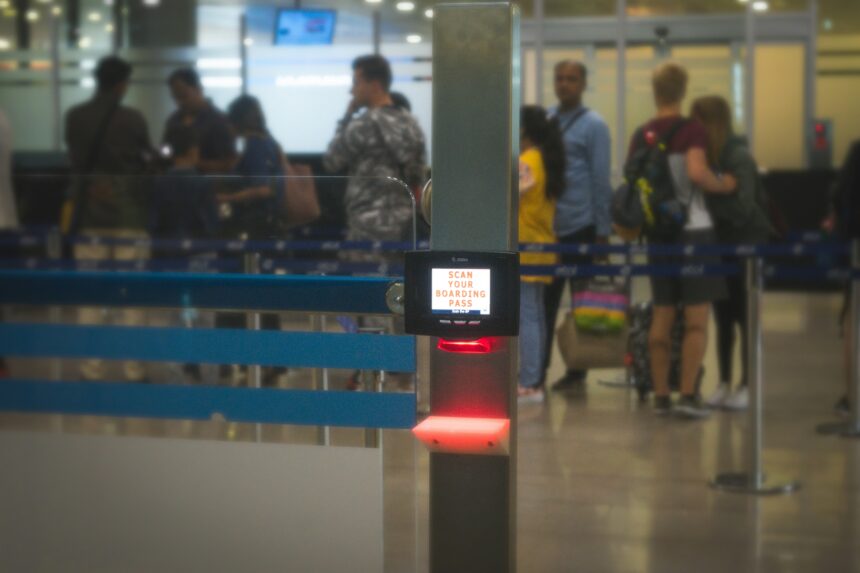
a boarding pass scanner ©Arshad Pooloo
A boarding pass scanner © Arshad Pooloo
SHARE

A new report from the International Air Transport Association says airports no longer need physical walls between domestic and international departures. Biometrics can do the job instead.

The study, launched on November 6 in Istanbul and produced with engineering firm AtkinsRéalis, claims the change would save major airports millions of dollars a year while cutting CO₂ emissions.

A person wearing black shirt and blue jeans looking up at an airports departure board
An departure board ©Daniel Lim

Why the split exists today

Most airports still keep domestic and international passengers in separate streams because of immigration rules, security requirements and decades-old terminal layouts.

Nick Careen, IATA’s SVP for Operations, Safety and Security, says that it is now outdated.

“Regulatory requirements and technology limitations have meant that domestic and international departure passenger flows need to be physically separated at many airports. That’s no longer the case.”

A yellow Labrador retriever airport security dog lying on black tiled floor
An airport security dog resting © Artem Labunsky

The money on the table

– Shared departure halls and joint staffing could cut operating costs by up to 11 %.

– Ground-handling companies at large hubs would save roughly $5.3 million annually.

– A mid-sized airport handling 10 million passengers a year could avoid around USD 80 million in expansion costs that would otherwise be needed for duplicate facilities.

On the environmental side, IATA calculates the industry would shed 18,000 tonnes of CO₂-equivalent each year – the same as removing 4,000 cars from the roads.

A white biplane landing in Zurich
A white biplane landing in Zurich © Pascal Meier

How it would actually work

The Domestic and International Passenger Integration Program (DIPIP) lays out three phases that stay within current regulations:

1. Baseline – shared terminal space with biometric identity checks at key points.

2. Integrated – domestic and international passengers mix freely; digital systems handle border screening in the background.

3.End-state – passengers complete all identity and border formalities remotely before they even reach the airport.

Careen stresses that co-operation is the only way it happens. “Collaboration is essential to unlocking the benefits of integrated passenger flows.”

Gareth Vest, UK & Ireland Aviation Market Director at AtkinsRéalis, said the research shows clearly how digital identity and biometrics can deliver big cost savings and a far better passenger experience.

A group of people standing around a terminal
A group of people standing around a terminal © Albert Stoynov

Bottom line

The idea is straightforward: let technology enforce the rules so airports don’t have to build two of everything.

Privacy and data-security questions still need answers, and not every country will move at the same speed. But for passengers stuck shuffling between segregated terminals, the prospect of one single, faster journey is hard to argue with.

What do you think – ready to let your face replace half the queues at the airport? Drop your take in the comments.

Share your thoughts below, and follow Travel Radar for more insights into aviation’s next big leap.


You Might Also Like

Ryanair Maintains Low Fares As Profit Stagnates
Aberdeen Airport Wins Top Business Award in 2026
ANA Group Announces Flight Schedule for 2026
South Korea admits Airport Safety Failure Contributed to Jeju Air Crash Fatalities
After Disruptive Military Operation FAA Lifts Airspace Restrictions
Share This Article
Facebook Twitter Email Copy Link
What’s your thoughts?
Love0
Sad0
Happy0
Angry0
ByShaq Qassim
Aviation Reporter - A traveller at heart, I write about flight paths and airport rhythms from my base in Cymru (Wales). My time spent living in Japan shifted what travel means to me - it became less about schedules and more about experiencing real life through movement. Moments in time, I'd love to help others experience.
Previous Article flydubai signs MoU for 75 Boeing 737 MAX Airplanes © Boeing flydubai signs MoU for 75 Boeing 737 MAX Airplanes
Next Article An Emirates plane grounded with the Dubai Skyline in the background Emirates Inks MOU with Rolls-Royce for In-House A380 Engine MRO Starting 2027
Leave a Comment

Leave a Reply Cancel reply

Your email address will not be published. Required fields are marked *


Stay Connected

FacebookLike
TwitterFollow
InstagramFollow
YoutubeSubscribe

Trending News

Image of cabin isle where passengers are sat in their seats, listening to the cabin crew. 2017 © Quilia
Child-free travel packages to be launched amidst controversy
Aircraft Airlines Aviation
An Archer electric aircraft with tail number N703AX flies over Alcatraz Island with the San Francisco skyline and Bay Bridge visible in the background.
Archer’s Electric Air Taxi Takes the Skies of the Bay Area
Aircraft Aviation Technology
A picture of an airBaltic Airbus A220-300 aircraft on take-off
airBaltic Launches In-Seat Ordering
Aviation Points & Loyalty Technology
Frankfurt skyline at dusk viewed from the banks of the Main River, with illuminated skyscrapers, city lights reflecting on the water, and people walking and sitting along the riverside promenade.
Global Aviation Leaders Uniter at the Routes World 2026 Opening
Airshow & Events Careers
A red, white, and blue, British Airways jet flying over a layer of cloud.
British Airways Announces New Avios-Only Flights
Airlines Aviation Points & Loyalty

Travel Radar is the leading digital hub for all things aviation and air-travel. Discover our latest aviation news, aviation data, insight and analysis.


Discover

  • Latest News
  • Subscribe
  • Weekly Digest
  • Contact Us
  • Privacy Policy
  • About Us
  • Advertising
  • Media Coverage
  • Press & Events
  • Join Our Team
  • Our Brands

Signup to our Newsletter!

And get the latest aviation news via our weekly news digest!

© Travel Radar Media Ltd. 2015-2026 | ISSN #2635-0696 | Trademark #UK00003579704
adbanner
Welcome to the TR Community!

Sign in to your account

Not a member? Sign Up