


Travellers, when boarding and using plane services, want the comfort of knowing they are flying without any substantial worry. For many passengers of colour, their worries stem from being racially profiled before and after borders. There are often reports of differential treatment and bias at security screenings and border controls, but travellers’ experiences are not linear and cannot, by any means, be summarised. The real question is: How prevalent is the issue?
How screening power works: policies and limitations
We’re going to break down the facts, the profiling complaints, the enforcement policies and the discrimination patterns for persons of colour (POC) and racialised travellers in navigating airports and borders. With the help of civil rights complaint data, policy frameworks, academic research on bias, and documented legal cases, this will help to map out how racial profiling occurs and is (or isn’t) tracked.
Screening is an essential part of an airport’s process and is key to every traveller’s journey before boarding towards their destination. To eliminate prejudice, formal policies, with their own limitations, govern profiling and screening.
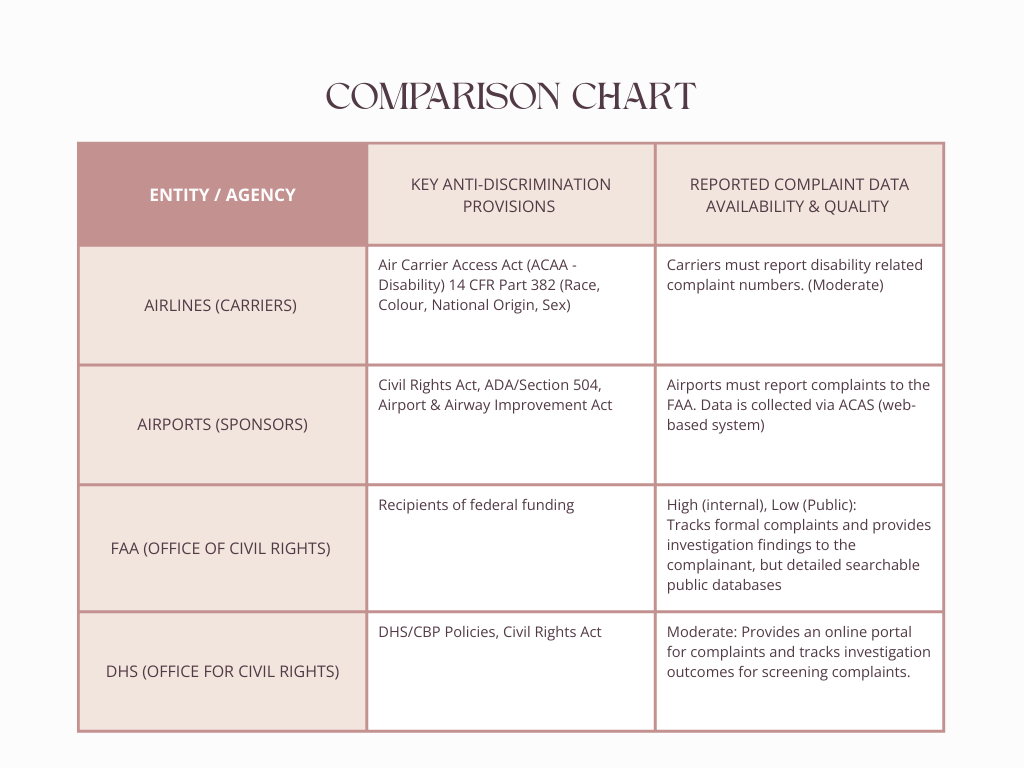
The main entity protecting and safeguarding the rights of many minorities is the U.S. Transportation Security Administration, which prohibits screening based on race, ethnicity, or national origin and investigates civil rights complaints. The Federal Aviation Administration (FAA) further prohibits discrimination based on race, colour, national origin, or limited English proficiency at federally assisted airports. But while policies exist to prevent discrimination, there is little publicly reported data on their outcome.
In the UK, policies are centred around the Terrorism Act 7 of 2000, which grants officers leeway to stop, question and examine individuals at ports or airports without reasonable suspicion.
Complaint patterns and screening disparities
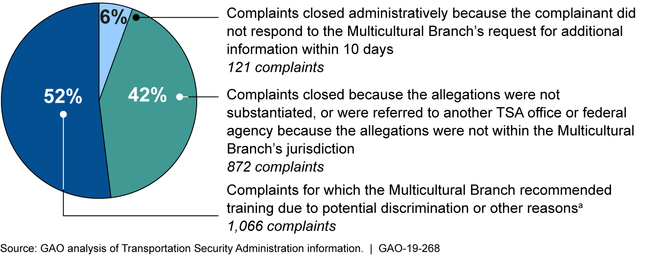
From October 2015 to February 2018, the Transportation Security Administration (TSA) contact centre documented 3,663 complaints related to passenger screening and civil rights violations, with a majority alleging that screening measures were discriminatory or profiling based on personal attributes. An example is pat-downs based on race and ethnicity, which are mostly random and, in most cases, unnecessary. Tarrant County College (TCC) received passenger complaints alleging that screening procedures were aggressive or inappropriate for many passengers of colour, including senior citizens.
A Government Accountability Office (GAO) review of TSA complaints found that among 2,059 civil rights complaints, approximately 1,066 (about 52%) showed indications of potential discrimination or unprofessional conduct and concluded that race was the factor. These figures do not necessarily mean that profiling was proven, but they show how many travellers had perceived enough discrimination to file a complaint. It is important to note that federal reporting entities, such as the GAO and the U.S. GOV, do not disaggregate race data beyond public statistics, making it difficult to draw systematic conclusions.
These figures were reported a couple of years ago, but given the current climate of U.S. profiling, there is cause for concern about how this will translate into the broader aviation industry. As of September 2025, a Supreme Court decision led federal immigration agents (ICE) to perform duties more freely by having immigration stops based on factors that many have deemed to be racial profiling. There are concerns that the current state of profiling in America can only lead to more airports and checkpoints, where there will be more targeted individuals being discriminated against based on their perceived immigrant status. The use of technology and AI in facial recognition also raises questions about false-positive rates, specifically for African American females, highlighting that not all algorithms perform or perceive them equally.
Global context – border checks and legal actions
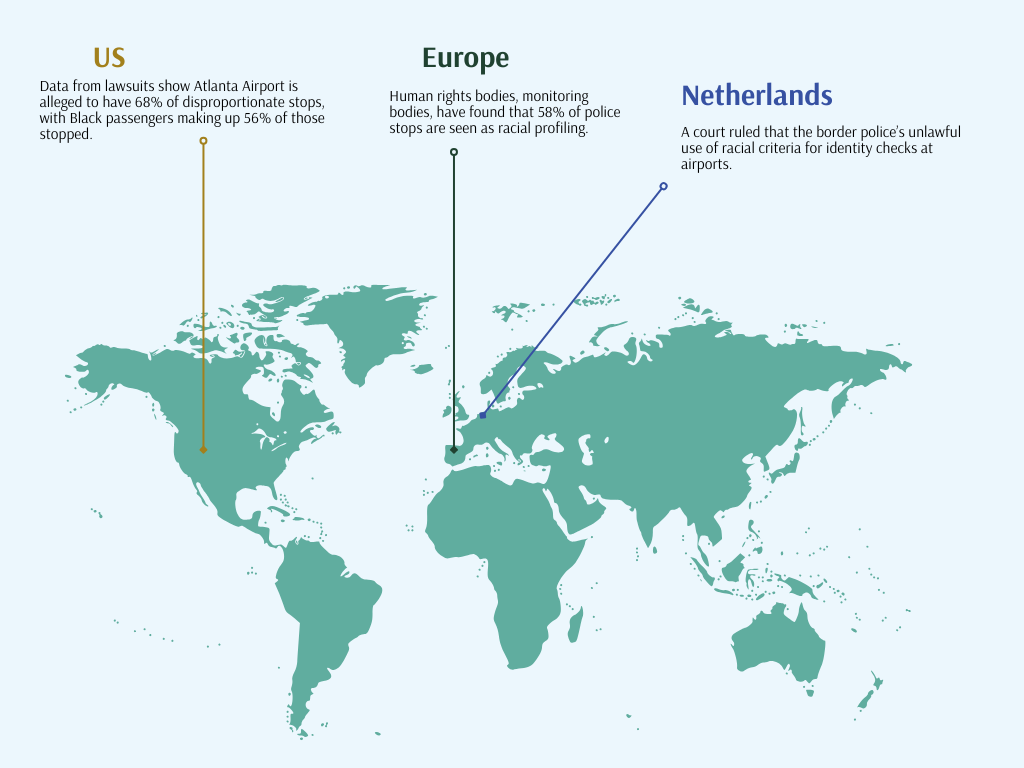
Racial profiling in airports is not only a problem in the U.S. but a global issue, as in the Netherlands, it made news that a court ruled border police “unlawfully uses of racial criteria” for identity checks at airports and train lines after two citizens and rights groups sued the government. Racial profiling can be used as a crutch to discriminate against a group of people in the guise of keeping order. The lawsuit against Clayton County police is another example of law enforcement’s abuse of power driven by their own prejudice and bias. It was alleged that disproportionate stops of people of colour from the lawsuit had been 68%, with Black passengers making up 56% of those stopped, despite there being a minimal drug seizure percentage.
These biases also appear in Europe, as human rights monitoring organisations note that border checks and police stops still occur in ways that are perceived as racially discriminatory. The survey showed that about 58% of police stops by EU police are characterised as racial profiling. There are many more testaments of racial profiling and prejudice through the screening application, but what are we doing to rectify this? In the U.S., law officials in 2026 released a reform demand tied to the Department of Homeland Security’s explicit restriction on racial profiling by border control and immigration officers, the same agencies that are deployed within airports. It stresses that stopping, searching and questioning based on the person’s skin colour, without a factual basis, are unconstitutional.
Beyond the data: limits to current reporting
Because many government agencies don’t publicly release comprehensive race screening or border stop data, it is hard to truly quantify this ongoing issue. Although this leaves further gaps and does not truly investigate whether racial profiling is rampant in the screening process, it is important to note that the data provided should still be taken into account. If 3,663 complaints were filed from 2015 to 2018, imagine this number has tripled since the recent, politically charged movements. The data is easily malleable to the injustices that many people of colour face to this day, and it will only get worse.
There have been many instances where airlines play a part in turning a blind eye to injustices that happen to POC travellers, which aren’t limited to only before the borders. In 2018, Ryanair came under fire after a passenger went on a tirade of racist rhetoric, calling a Jamaican woman an “ugly black bastard”. Cabin crew in the video that was shared in the incident did little to stop the abuse, showing that there is a lack of training or enforcement of policy when a POC is being targeted for their skin colour.
Why does this matter in aviation?
Trust is the foundation of aviation. It gets us from A to B and puts the safety of those coming in and out of a country at the forefront. When screening is disproportionately affecting certain racial or ethnic groups, it can undermine passenger confidence and create a distrust between the airport staff and the travellers.
Security procedures post-pandemic have definitively had an effect on security procedures, not just becoming a civil rights issue, but also questioning the credibility of the industry.
Want to know more about airport screening and security? Follow us on Travel Radar for the latest aviation news.






Your work has such a lasting positive impact 💯 on everyone who discovers it
Your work continues to inspire positive change in so many lives