By using this site, you agree to the Privacy Policy and Terms of Use.
Accept
Travel Radar - Aviation NewsTravel Radar - Aviation News
  • Breaking News
  • Aviation
    • Aircraft
    • Airlines
    • Airshow & Events
    • Careers
    • Manufacturing
  • Travel
    • Airports
    • Points & Loyalty
    • Technology
    • Trip Reviews
  • Newsletters
  • Aircraft for Sale
Reading: WiFi On-Board: How does In-Flight WiFi Work?
Share
Sign In
Notification Show More
Font ResizerAa
Font ResizerAa
Travel Radar - Aviation NewsTravel Radar - Aviation News
  • Breaking News
  • Aviation
  • Travel
  • Newsletters
  • Aircraft for Sale
  • Breaking News
  • Aviation
    • Aircraft
    • Airlines
    • Airshow & Events
    • Careers
    • Manufacturing
  • Travel
    • Airports
    • Points & Loyalty
    • Technology
    • Trip Reviews
  • Newsletters
  • Aircraft for Sale
Signin Sign In
Follow US
Copyright © Travel Radar Media Ltd. 2025 | All Rights Reserved
Travel Radar - Aviation News > News > WiFi On-Board: How does In-Flight WiFi Work?

WiFi On-Board: How does In-Flight WiFi Work?

Travel Radar
Last updated: 7 January 2021 17:02
By Travel Radar Staff
4 Min Read
Share
©Travelerswifi
SHARE

Isn’t it frustrating to switch off your phone and not stay connected with your friends through social media while travelling in an aircraft? Or how about unable to watch your favourite show on Netflix? Fortunately, this is changing. In-flight WiFi is becoming more common on aircraft these days. Many airlines around the globe are starting to offer WiFi internet services on-board to help them stay connected with their loved ones. But how does an aircraft offer WiFi when it flies 38,000 feet high and 400 knots fast?
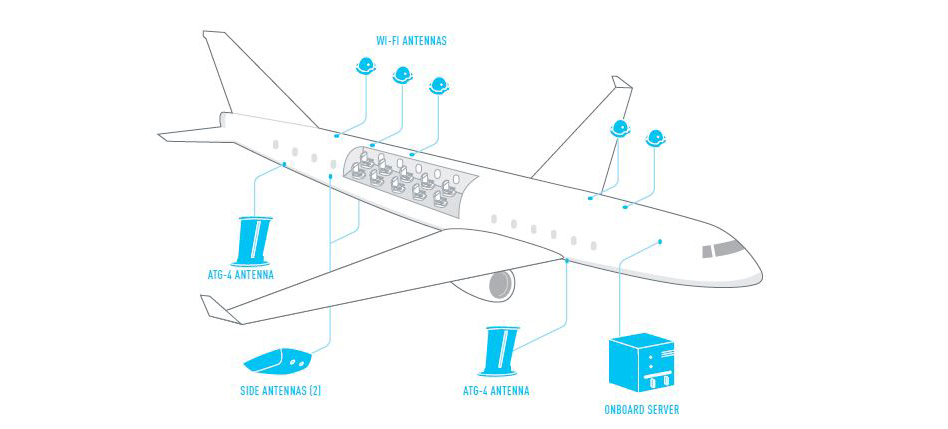
Picture showing aircraft wifi antenna
An illustration showing antennas placed on an aircraft providing WiFi service ©Gizmodo

How does aircraft WiFi work? 

To provide WiFi to passengers in the air, airlines use either land-based towers or satellites. Land-based internet is similar to cellphones. Cellphone towers beam 3G internet to aircraft fixed with antennas. This technology is called Air-to-Ground (ATG). Two or more antennas are fixed on the belly of the aircraft to capture signals from cell towers. Since aircraft travel at 400 knots (800 km/h approx.), at a certain point, it has to connect to another cell tower. Some antennas do this with motors that tilt towards the tower capturing the signal. However, ATG provides with only 3-Mbps of bandwidth making ineffective to stream videos. But internet speeds are rising as technology advances. Also, this technology does not work when aircraft flies over oceans, such as transatlantic routes. This is where satellites come into the picture.
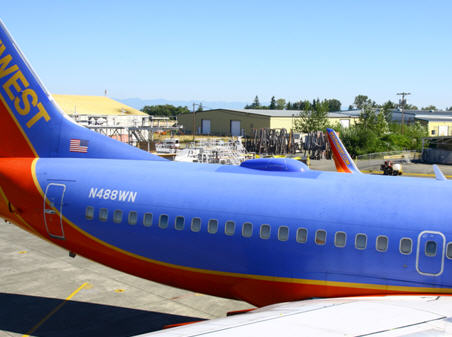
The bump with the antenna inside fixed on top of an aircraft to receive WiFi signals. ©Flickr

Satellite WiFi, the future of in-flight connectivity

The other method to receive WiFi signals in-flight is to connect to satellites in geostationary orbit. Antennas placed inside of a radome on top of an aircraft connect to Ku or Ka-band satellites. It offers a broader bandwidth although signals from satellites are transmitted over hundreds of kilometres. The Ku-band satellite offers up to 30-Mbps WiFi speed, making it easy to stream videos or video call your business partners. Gogo, one of the largest in-flight WiFi providers, introduced a 2 Ku-band technology which uses two antennas to offer speeds up to 70-Mbps.

Interestingly, radomes covering antennas placed on top of an aircraft creates a lot of drag. To reduce the drag and eventually save fuel, thinner radomes have to be designed. A company named Kymeta is developing a new kind of an antenna called “mTenna” – which is less than half an inch thick and 20-40 inches in diameter.

Kymeta Radome Mtenna
Kymeta “Mtenna” ©Wired

Numerous airlines across the US, Europe and Asia offer in-flight services but for a price. There are major airlines like Emirates, Norweigan, Air China, Qatar Airways and many more which offer free in-flight WiFi. Other airlines too will join the race as customer demand for in-flight WiFi is increasing. 

Currently, around four billion passengers fly every year around the globe with only 25 per cent of aircraft equipped to serve in-flight WiFi. In 2018, the airline industry collected ancillary revenues up to $1 billion for providing in-flight internet.

Ancillary revenue from in-flight internet service is expected to reach $30 billion in 2035 as IATA forecasted that the number of passengers would double to 8 billion in the next 20 years. Over the next few years, connectivity will increasingly become a standard aircraft feature.


You Might Also Like

What is Being Done to Fix the Chaos at UK Airports?
Sinagapore Airlines and Lufthansa to expand Joint Venture in Asia
Emirates Celebrates a Colourful and Happy Holi Onboard Flights to India
Flexjet Reveals Exclusive Collaboration with Luxury Luggage Brand, Globe-Trotter
Skiing La Dolce Vita: Milan as best gateway for skiing in Italy
Share This Article
Facebook Twitter Email Copy Link
What’s your thoughts?
Love0
Sad0
Happy0
Angry0
Travel Radar
ByTravel Radar Staff
Follow:
Articles from guest contributors wishing to remain anonymous are credited to this account. Want to contribute to Travel Radar either in-name, or anonymously? Get in touch: [email protected]
Previous Article Inca Architecture in Peru Trek or Train to Machu Picchu in Peru
Next Article © Norwegian Air Shuttle Norwegian’s Scandinavian Staffing Subsidiaries Bankrupt
Subscribe
Login
Notify of
guest

guest

0 Comments
Oldest
Newest Upvoted
Inline Feedbacks
View all comments

Stay Connected

FacebookLike
TwitterFollow
InstagramFollow
YoutubeSubscribe

Trending News

Flynas aircraft A320neo flying in the blue sky.
Syria and the Saudi Flynas launch new airline, Flynas Syria
Airline Economics Airlines Airports Aviation Travel
A side view of a Japan Airlines Airbus A350-1000 in mid-air with its landing gear deployed. The aircraft features a white fuselage with "JAPAN AIRLINES" written in black and the iconic red "Tsurumaru" crane logo on the tail, flying over a lush green hillside.
Japan Airlines is upgrading Boeing 787-9 with new business class
Aircraft Airlines Aviation Travel
A side profile of a United Airlines Boeing 737 MAX 8 parked on a concrete airport taxiway under a bright blue sky with scattered white clouds. The aircraft features the modern "Evolution" livery with a blue tail globe, blue engine nacelles, and "UNITED" in large blue lettering across the white fuselage.
71% of United Airlines flight attendants reject tentative labour contract
Airline Economics Airlines Aviation Careers
Aerial view of Terminal 1 at Rio de Janeiro's Galeão International Airport (GIG) during the 2016 Olympics.
Brazil Launches Auction for Galeão Airport, Targets New Investors
Airports Aviation Travel
Boeing Singapore Airlines aircraft flying in the blue sky.
Boeing Signs Largest Landing Gear Exchange Deal with Singapore Airlines Group
Aircraft Airline Economics Airlines Aviation

Travel Radar is the leading digital hub for all things aviation and air-travel. Discover our latest aviation news, aviation data, insight and analysis.


Discover

  • Latest News
  • Subscribe
  • Weekly Digest
  • Contact Us
  • Privacy Policy
  • About Us
  • Advertising
  • Media Coverage
  • Press & Events
  • Join Our Team
  • Our Brands

Signup to our Newsletter!

And get the latest aviation news via our weekly news digest!

© Travel Radar Media Ltd. 2015-2026 | ISSN #2635-0696 | Trademark #UK00003579704
wpDiscuz
adbanner
Welcome to the TR Community!

Sign in to your account

Not a member? Sign Up