
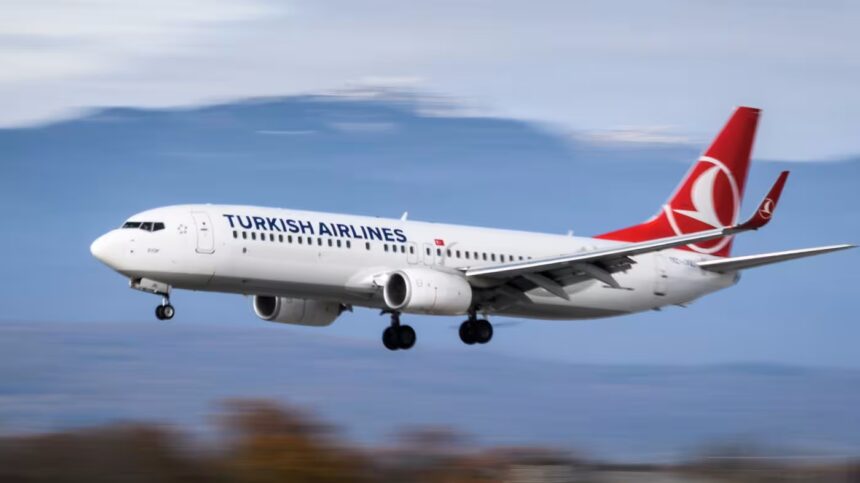
Turkish Airlines is restoring a long-absent air link between Istanbul (Türkiye) and Yerevan (Armenia) this year, with the airline announcing its plans to launch scheduled passenger flights from March 11, 2026. This daily route will connect Turkish Airlines hub, Istanbul Airport, with Zvartnots International Airport, and shall be initially operated using narrowbody aircraft.
Capacity will increase progressively through mid-2026, as beyond its commercial role, the route is widely viewed as a confidence-building measure amid renewed trade links in the South Caucasus. Altogether, the move represents an important step to normalize relations between the two countries, which have not maintained formal diplomatic ties for decades.

Routes Details and Network Strategy
The Istanbul-Yerevan service will begin with seven weekly round-trip flights, with Turkish Airlines offering a daily schedule from launch. From May 14 2026, the frequencies will rise to 10 flights per week, before increasing again on June 15, 2026, to 14 weekly services, doubling capacity to meet demand during the peak summer season.
Primarily, flights are expected to be operated by Boeing 737-800 aircraft, aligning with Turkish Airlines’ short-haul fleet strategy. Moreover, the route strengthens Istanbul Airport’s role as a major global hub, providing passengers traveling to and from Armenia with access to Turkish Airlines’ extensive long-haul network across Europe, North America, the Middle East, and Asia. Pegasus Airlines currently operates daily flights between Istanbul’s Sabiha Gökçen Airport and Yerevan, but Turkish Airlines’ entry adds network depth and connectivity.

Political Context and Regional Impact
Direct air services between Türkiye and Armenia have been limited for decades, largely shaped by closed land borders and unresolved political tensions since 1993. However, aviation has emerged as one of the most practical areas for progress. The Istanbul-Yerevan route complements ongoing discussions around reopening rail links and restoring cross-border movement.
For Armenia, improved access to Istanbul enhances both tourism and international connectivity, while for Türkiye, the route reinforces Istanbul’s position as a regional transit hub bridging Europe and Eurasia. Overall, Turkish Airlines’ expansion to 14 weekly flights is testament to the route’s commercial viability.
Do you think this route will be commercially successful? Let us know your thoughts in the comments!