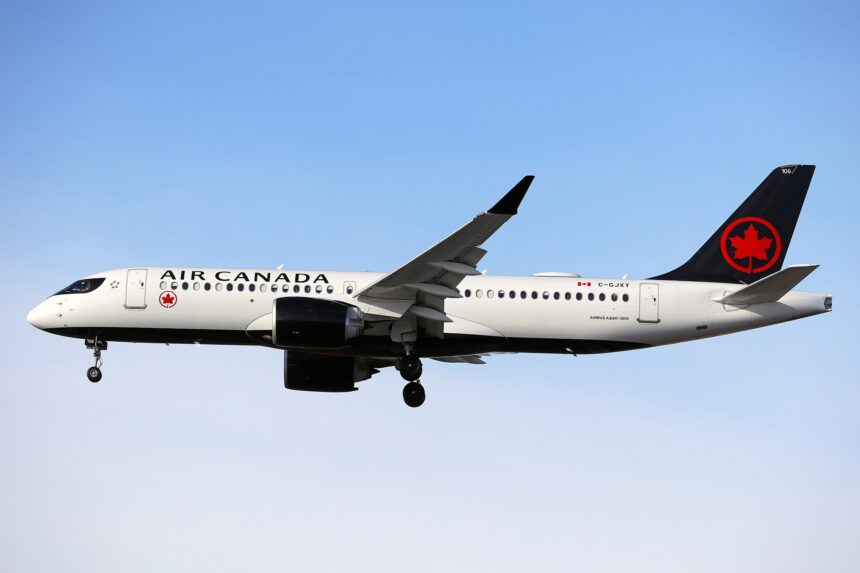
Air Canada has received a rare slot waiver from the Federal Aviation Administration (FAA) after prolonged engine maintenance delays forced disruptions to its Airbus A220-300 operations.
FAA Grants Exception as Engine Delays Mount
The waiver, published by the FAA on December 9, 2025, covers part of the Summer 2025 scheduling season, specifically March 31 to April 30, when the airline struggled to meet LaGuardia Airport’s strict slot usage requirements.
The FAA acknowledged that ongoing supply chain and servicing delays for the Pratt & Whitney PW1500G engines were outside the carrier’s control.
Without the waiver, Air Canada risked violating the US regulator’s 80% use-it-or-lose-it slot rule, which determines whether airlines can retain their historic slot rights at slot-controlled airports like LGA, JFK, and DCA.
The waiver includes one condition: Air Canada cannot transfer the protected slots if it ever ceases operations at LaGuardia.
A220 Fleet Pressures Hit US–Canada Routes
Air Canada first requested relief in March 2025, citing well-documented GTF engine issues affecting its A220 fleet.
At the peak of the winter 2024–2025 season, seven of 34 A220-300s were grounded, heavily disrupting East Coast operations from Toronto Pearson and Montreal Trudeau.
The airline noted that while many engines were eventually cycled back into service, around 5% of the fleet remained unavailable throughout early 2025.
This forced schedule reductions and created gaps in operating four LaGuardia slots during the affected month.
The problems were compounded by a simultaneous pilot shortage at Jazz, Air Canada’s regional partner, further limiting its ability to keep flights running at full capacity.
GTF Maintenance Delays Ripple Across Global Operators
Although the PW1500G variant powering the A220 was not hit by the powder-metal crisis affecting the PW1100G on A320neo aircraft, repair delays have remained persistent. Airlines worldwide have been forced to park jets for months at a time while awaiting engines.
In 2025, A220 operators reported lengthy turnaround times for engine repairs, with some units sitting in maintenance facilities for nearly a year.
Cirium data shows that by early 2025, over 80 A220-300s were grounded globally, though the figure has gradually declined. As of December 2025, 342 A220-300s are flying, while 61 remain parked.
For Air Canada, the FAA waiver ensures it retains its valuable LaGuardia access while it works through lingering engine bottlenecks, an issue expected to ease later in 2025 as supply chain improvements take hold.
Do you think regulators should offer more flexibility when airlines face manufacturer-related delays? Share your thoughts in the comments below.