By using this site, you agree to the Privacy Policy and Terms of Use.
Accept
Travel Radar - Aviation NewsTravel Radar - Aviation News
  • Breaking News
  • Aviation
    • Aircraft
    • Airlines
    • Airshow & Events
    • Careers
    • Manufacturing
  • Travel
    • Airports
    • Points & Loyalty
    • Technology
    • Trip Reviews
  • Newsletters
  • Aircraft for Sale
Reading: Preliminary investigation into Fatal Hong Kong Plane Crash finds Engine Accelerated After Landing
Share
Sign In
Notification Show More
Font ResizerAa
Font ResizerAa
Travel Radar - Aviation NewsTravel Radar - Aviation News
  • Breaking News
  • Aviation
    • Aircraft
    • Airlines
    • Airshow & Events
    • Careers
    • Manufacturing
  • Travel
    • Airports
    • Points & Loyalty
    • Technology
    • Trip Reviews
  • Newsletters
  • Aircraft for Sale
Signin Sign In
Follow US
Copyright © Travel Radar Media Ltd. 2025 | All Rights Reserved
Travel Radar - Aviation News > News > Aviation > Aircraft > Preliminary investigation into Fatal Hong Kong Plane Crash finds Engine Accelerated After Landing
AircraftAviationIncidents & Accidents

Preliminary investigation into Fatal Hong Kong Plane Crash finds Engine Accelerated After Landing

Rayan-Amalan Nirmalraj
Last updated: 20 November 2025 09:50
By Rayan-Amalan Nirmalraj
4 Min Read
Share
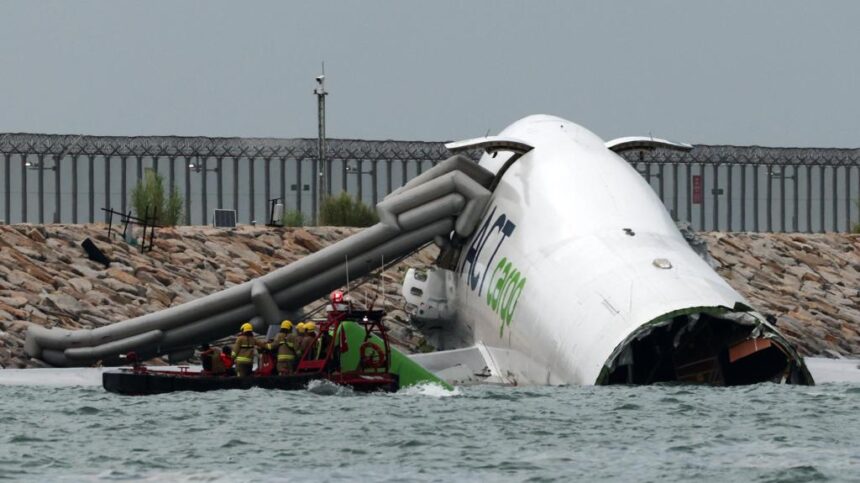
Hong Kong plane crash preliminary report released
Hong Kong plane crash preliminary report released © Hong Kong Airport Authority
SHARE

Preliminary investigation on the fatal Hong Kong flight crash that happened last month found that an engine accelerated after landing, according to Hong Kong’s Air Accident Investigation Authority (AAIA). A cargo plane operated by Turkish-based ACT Airlines on behalf of Emirates lost control while landing at Hong Kong International Airport, killing two workers on the runway.
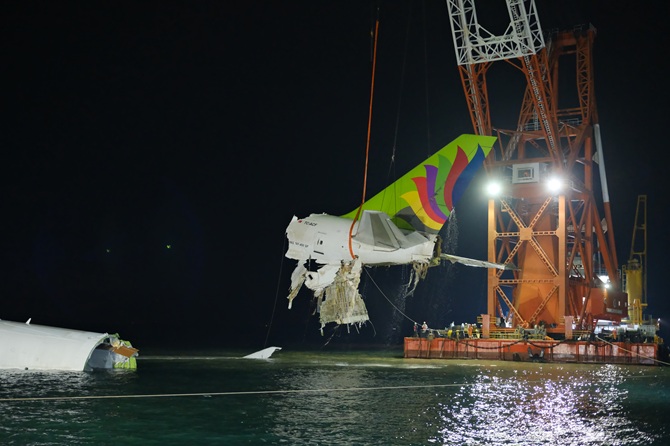
Aircraft tail being lifted from the sea after Hong Kong plane crash ©  Hong Kong Airport Authority
Aircraft tail being lifted from the sea after Hong Kong plane crash © Hong Kong Airport Authority

Preliminary report findings:

A preliminary report from AAIA released on Tuesday revealed the reasons behind the cargo plane crash in October at Hong Kong International Airport. The investigation is being conducted with a panel that includes experts from “the Turkish Transport Safety Investigation Centre (representing the country of registration and operator), the US National Transportation Safety Board (representing the country of design and manufacture of the aircraft involved), and the consultant Boeing Company (representing the manufacturer of the aircraft involved). The crew has also been very cooperative with the investigation,” the Civil Aviation Authority said in a Facebook post.

According to the report, the thrust reverser on engine 4, one of four engines, was inoperative, which is acceptable under aviation rules. The captain of the aircraft took over the control from the first officer, who had flown the flight, because the aircraft’s automatic braking system disengaged while landing.

Seconds later, engine 4, the engine where the thrust reverser was not working, accelerated to 90% thrust and reached 106% to 107% thrust in 12 seconds.

The other three thrust reversers were activated after that, which made the captain lose control, and the aircraft left the runway to make it to the nearby sea before hitting the vehicle where two workers were present.
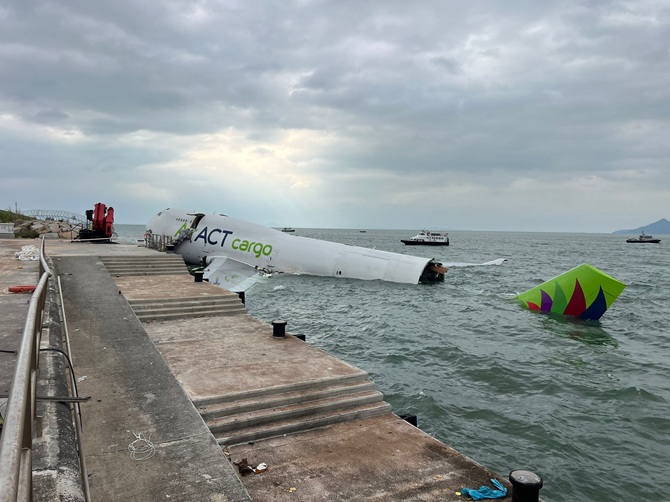
Fatal Hong Kong plane crash ©  Hong Kong Airport Authority
Fatal Hong Kong plane crash © Hong Kong Airport Authority

Aftermath of the accident:

This accident was reported as the deadliest accident in Hong Kong International Airport in more than 25 years.

All four crew members in the aircraft escaped without any injuries. The plane was destroyed completely, with the tail of the aircraft separated from the aircraft on impact. The investigation is still ongoing.

AAIA is investigating to get further evidence on the circumstances and causes of the accident. The investigation will also determine what caused the no.4 thrust pod to be in full thrust position and whether there were issues that caused it to get out of control, including the possibility of a technical failure.

The authority, in the post, said (translated to English):

“The Civil Aviation Accident Investigation Agency has removed the thrust valve panel and related modules and sent them to the aircraft manufacturer for detailed analysis to determine whether there are any technical problems with the electrical or mechanical aspects, etc.

In the next phase, as more in-depth investigation is conducted, the Civil Aviation Accident Investigation Agency will collect more data and perform detailed analysis, focusing on technical issues related to aircraft systems and performance, engineering issues and maintenance records of aircraft systems, operational issues related to crew qualifications and experience, human factors issues, and safety management system issues. Although investigations of the same size usually take years, the Civil Aviation Accident Investigation Agency aims to complete a full report within a year.”

For more updates, follow Travel Radar. 

You Might Also Like

Which Airline has the Best Food? Your Favourite In-Flight Food Revealed
Fog-related travel chaos to persist throughout the weekend
Emirates Donates 12,000 Eye Masks to Transform Vision Training in the UK
Venezuela Aviation Ban Turns Airspace Into Political Leverage
IndiGo expands route from Hindon to nine Indian Cities
Share This Article
Facebook Twitter Email Copy Link
What’s your thoughts?
Love0
Sad0
Happy0
Angry0
Rayan-Amalan Nirmalraj
ByRayan-Amalan Nirmalraj
Aviation Reporter - A UK-based journalist with a strong background in social media content creation, video production and communications, honed through work in sports journalism and research. He brings this dynamic skill set to cover aviation and travel, exploring how airlines, airports and digital media intersect in a rapidly evolving global network.
Previous Article WestJet aircraft Skip and WestJet Rewards Join Forces to Link Loyalty Programs
Next Article flydubai signs MoU for 75 Boeing 737 MAX Airplanes © Boeing flydubai signs MoU for 75 Boeing 737 MAX Airplanes
Subscribe
Login
Notify of
guest

guest

0 Comments
Oldest
Newest Upvoted
Inline Feedbacks
View all comments

Stay Connected

FacebookLike
TwitterFollow
InstagramFollow
YoutubeSubscribe

Trending News

A photo of an Avelo aircraft
US Airline, Avelo, Extends Flights Through Summer 2026
Airlines Aviation
Air France partners with award-winning Apple TV to offer a better in-flight entertainment experience for customers.
Air France Partners with Apple TV for In-flight Entertainment
Airlines Aviation Technology Travel
An picture of two young men working for Air Canada
Air Canada Awarded Canada’s Top Employers for Young People 2026 for the Third Consecutive Year
Airlines Aviation Careers
An All Nippon Airways (ANA) Boeing 767-300ER airplane with landing gear down, flying low in front of a large white ANA maintenance hangar. The aircraft features the "Inspiration of Japan" livery, and the registration JA622A is visible on the rear fuselage. A second, smaller ANA aircraft is parked inside the hangar in the background under a clear, late-afternoon sky.
Flights Cancelled As Heavy Snowfall Hits Japan’s Northwest Coast
Aviation Breaking News Incidents & Accidents
IATA
IATA & CFM International Set To Renew Their Competitive Agreement
Manufacturing Technology

Travel Radar is the leading digital hub for all things aviation and air-travel. Discover our latest aviation news, aviation data, insight and analysis.


Discover

  • Latest News
  • Subscribe
  • Weekly Digest
  • Contact Us
  • Privacy Policy
  • About Us
  • Advertising
  • Media Coverage
  • Press & Events
  • Join Our Team
  • Our Brands

Signup to our Newsletter!

And get the latest aviation news via our weekly news digest!

© Travel Radar Media Ltd. 2015-2026 | ISSN #2635-0696 | Trademark #UK00003579704
wpDiscuz
adbanner
Welcome to the TR Community!

Sign in to your account

Not a member? Sign Up