By using this site, you agree to the Privacy Policy and Terms of Use.
Accept
Travel Radar - Aviation NewsTravel Radar - Aviation News
  • Breaking News
  • Aviation
    • Aircraft
    • Airlines
    • Airshow & Events
    • Careers
    • Manufacturing
  • Travel
    • Airports
    • Points & Loyalty
    • Technology
    • Trip Reviews
  • Newsletters
  • Aircraft for Sale
Reading: Historical World War II Bomb Detonates at Japanese Airport
Share
Sign In
Notification Show More
Font ResizerAa
Font ResizerAa
Travel Radar - Aviation NewsTravel Radar - Aviation News
  • Breaking News
  • Aviation
  • Travel
  • Newsletters
  • Aircraft for Sale
  • Breaking News
  • Aviation
    • Aircraft
    • Airlines
    • Airshow & Events
    • Careers
    • Manufacturing
  • Travel
    • Airports
    • Points & Loyalty
    • Technology
    • Trip Reviews
  • Newsletters
  • Aircraft for Sale
Signin Sign In
Follow US
Copyright © Travel Radar Media Ltd. 2025 | All Rights Reserved
Travel Radar - Aviation News > News > Travel > Airports > Historical World War II Bomb Detonates at Japanese Airport
Airports

Historical World War II Bomb Detonates at Japanese Airport

Karolina Kirillova
Last updated: 10 October 2024 12:48
By Karolina Kirillova
4 Min Read
Share
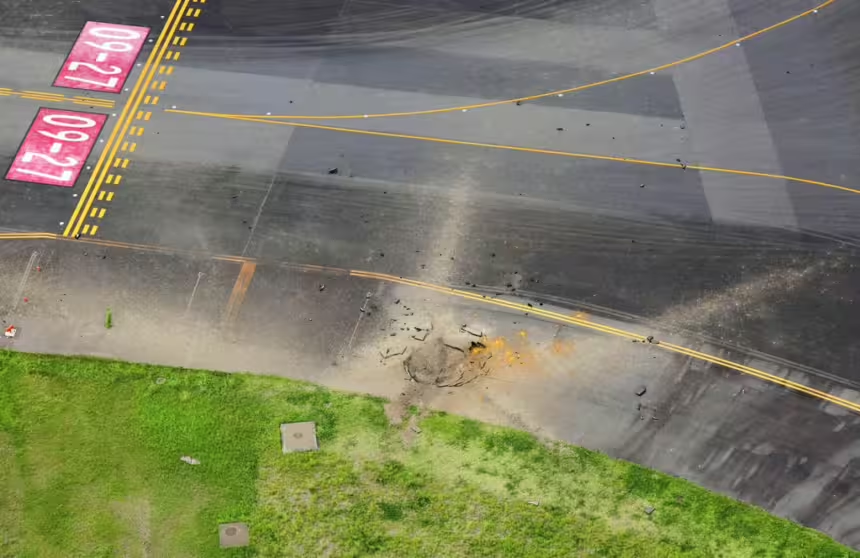
Historical Bomb Detonates at Miyazaki Airport on 2nd October 2024
Historical Bomb Detonates at Miyazaki Airport on 2nd October 2024. Photo by Kyodo News
SHARE

On 2 October 2024, a 500-pound bomb from the Second World War exploded at Miyazaki airport in Japan. It left a huge crater on the road. After the accident, all upcoming flights were stopped and cancelled. The airport became site of the explosion and bomb fragments which were too close to the runway. After World War II, in airports like Miyazaki built on former military sites, thousands of unexploded bombs are still being found during earthworks or construction work. It is undoubtedly a major problem.

Summary
Report of the ExplosionResponse of the Japan’s Government and Ground Self-Defense Force.Public Safety

Report of the Explosion

The bomb detonated in the morning near the taxiway, as a result of which a funnel 7 meters wide and 1 meter deep formed in the asphalt. Immediately after, 80 flights were cancelled and major domestic routes were changed while the workers checked the scene. One of the planes before the moment of the explosion had passed nearby and miraculously avoided tragedy and a larger disaster.

The bomb itself appeared in that place not by chance – it was most likely dropped during the Second World War wartime air raid. It laid motionless for decades, waiting for its hour. The same airport was also found to have other 2,300 unexploded bombs last year. This demonstrates that the area of Japan continues to deal with the reminder of past military conflicts. Even though the Japanese Self-Defense Forces safely dispose of thousands of found bombs weighing several tens of tons each year, explosions are still occurring.

Response of the Japan’s Government and Ground Self-Defense Force.

After the explosion, the Japan Army Self-Defense Forces quickly assessed the situation and confirmed the type of bomb that had exploded, based on data from the bomb disposal team. The authorities also reacted and the area was enclosed for inspection. No other unexploded ordnance threatening public safety was found. Right after the inspection repair work began to restore the damaged taxiway from a crater. The rapid response of security offices allowed the airport to quickly deal with the consequences of the unexpected accident. Having minimal disruption, they reopened the airport the next day. The government’s swift reaction illustrated the value of developing organised reaction strategies for such incidents.
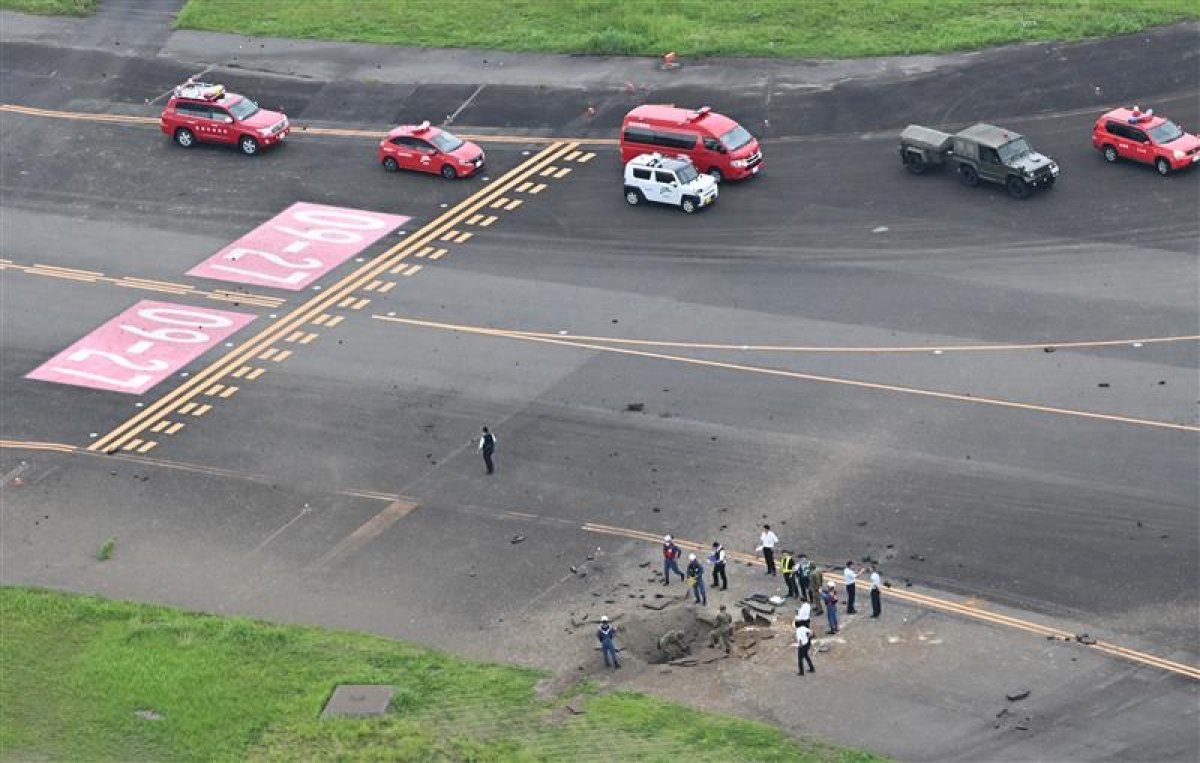
An image of the crater formed after the explosion of a bomb at Miyazaki airport and team of specialists around.
Bomb Disposal Specialists Examine the Crater Formed after the Explosion on the Taxiway. © Reuters

Public Safety

The problem of sleeping ammunitions in public places concerns not only Japan. After World War II, unexploded bombs continue to be found in many other countries, threatening the safety of populations and infrastructure. Even 79 years after the end of the fighting, these long-term consequences do not let it to be forgotten. To prevent such unforeseen incidents, the Japanese government continues to conduct regular inspections of areas such as airports and construction sites, and also organizes campaigns to raise awareness of the population about possible threats from suspicious objects.

You Might Also Like

On Your Radar: Discover the Charm of Salerno on the Stunning Amalfi Coast
WestJet to begin flights to Mexico City
First JD Weatherspoon Pub opens in Continental Europe
Affordability vs. Comfort: The Conflict Travellers Face Today
KLM warns Schiphol Against Possible Price Rises
Share This Article
Facebook Twitter Email Copy Link
What’s your thoughts?
Love0
Sad0
Happy0
Angry0
ByKarolina Kirillova
Aviation Reporter - Starting with Travel Radar as an intern in 2024, Karolina is a content writer and editor. With foreign language, independent research and digital marketing know-how, Karolina delves deep into the latest news to find the true story.
Previous Article Emirates Emirates Cancels Flights to Iran
Next Article ATR72-212 EcoJet Pushes Back Launch Date to 2025
Leave a Comment

Leave a Reply Cancel reply

Your email address will not be published. Required fields are marked *


Stay Connected

FacebookLike
TwitterFollow
InstagramFollow
YoutubeSubscribe

Trending News

Two people sit in the cockpit of an aircraft. The picture is taken from behind them, focusing on the controls, which are of various bright colours against a dark background. The backs of the two people's heads are stylistically blurred. The front windows can be seen. the the view of outside is just white-ish grey, as if surrounded by clouds.
Passengers Restrain Pilot due to Mid-Flight Medical Emergency
Aircraft Aviation Incidents & Accidents
Image shows a small blue aircraft (Piper PA-28-151 Cherokee Warrior N405DS) grounded at Delaware Airpark during the day.
Fatal small plane crash in Washington
Aircraft Aviation Incidents & Accidents
Tecnam P2012 traveller aircraft flying through the clouds
Air Oceania resumes flights after fuel shortage halts operations
Aircraft Airlines Travel
Avianca Boeing 787-8 side view in flight
Avianca to relocate Fort Lauderdale operations to Terminal 4
Airlines Airports Manufacturing
Interior view of a compact, modern control room with two workstations positioned on either side of the frame, each equipped with a desk, keyboard, mouse and large computer monitor. The monitors display complex data visualisations, including weather radar patterns on the left screen and dense network maps of flight paths and activity across North America on the central wall display and the right screen. Two ergonomic office chairs with mesh backs are positioned in front of the desks. The walls and ceiling are lined with smooth, light grey panels, and recessed lighting creates an evenly illuminated, high‑tech environment focused on monitoring and analysis.
FAA awards $875M contract to Air Space Intelligence
Aviation Points & Loyalty Technology

Travel Radar is the leading digital hub for all things aviation and air-travel. Discover our latest aviation news, aviation data, insight and analysis.


Discover

  • Latest News
  • Subscribe
  • Weekly Digest
  • Contact Us
  • Privacy Policy
  • About Us
  • Advertising
  • Media Coverage
  • Press & Events
  • Join Our Team
  • Our Brands

Signup to our Newsletter!

And get the latest aviation news via our weekly news digest!

© Travel Radar Media Ltd. 2015-2026 | ISSN #2635-0696 | Trademark #UK00003579704
adbanner
Welcome to the TR Community!

Sign in to your account

Not a member? Sign Up